

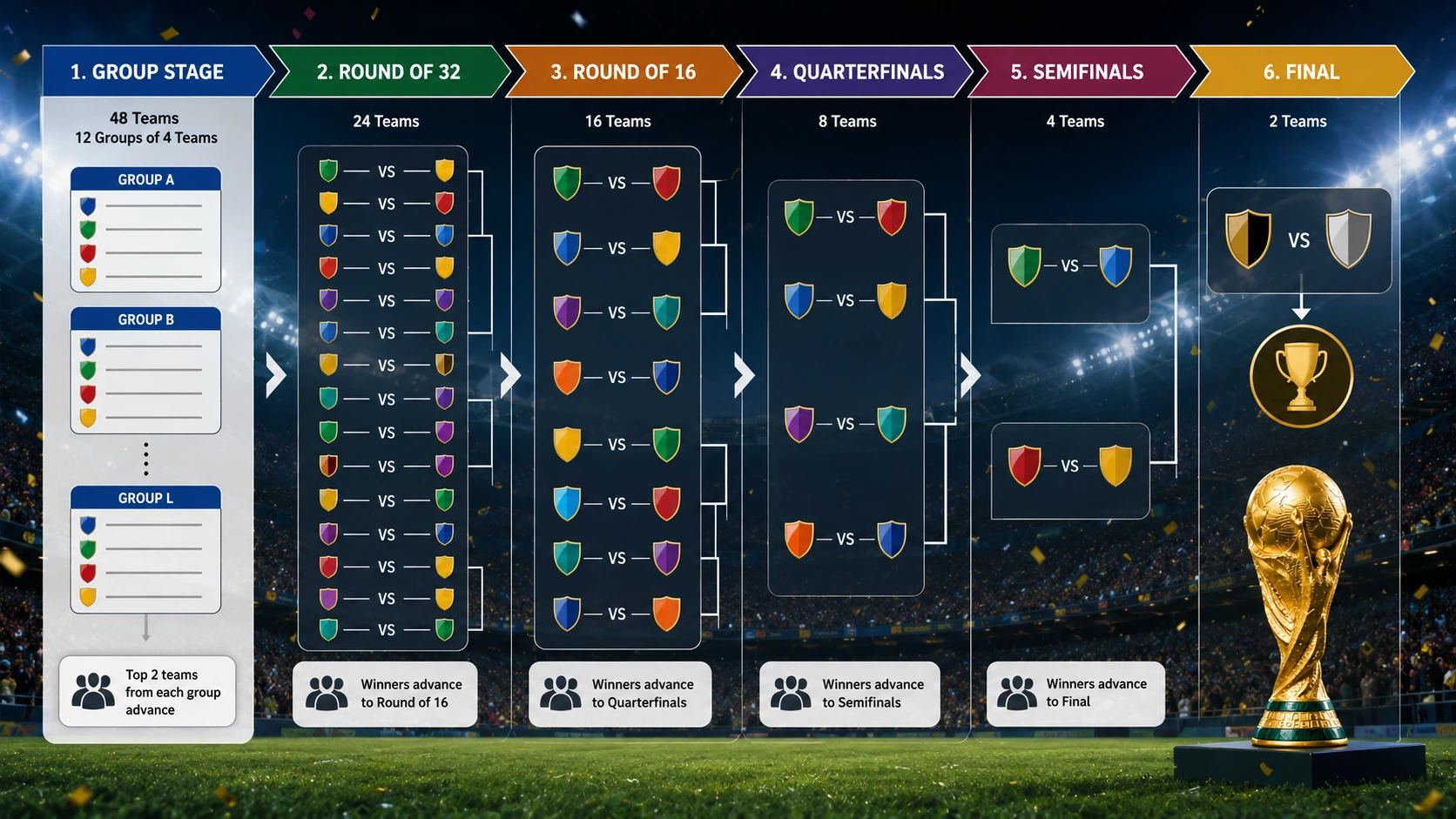
The 2026 FIFA World Cup format is unlike any tournament that came before it. For the first time in history, 48 national teams are competing up from 32 in every edition since 1998. That means new groups, a brand new round of knockout matches, and a much longer road to the final.
If you’re confused about how it all works who qualifies, how teams progress, what happens in the knockouts this is your complete, simple guide.
The Big Picture
| Detail | 2022 World Cup | 2026 World Cup |
|---|---|---|
| Teams | 32 | 48 |
| Groups | 8 groups of 4 | 12 groups of 4 |
| Total Matches | 64 | 104 |
| First knockout round | Round of 16 | Round of 32 (new!) |
| Host countries | Qatar | USA, Canada, Mexico |
| Duration | 29 days | 39 days |
| Final date | — | July 19, 2026 |
| Final venue | — | MetLife Stadium, New Jersey |
Phase 1: The Group Stage (June 11 – June 27)
How are teams divided?
The 48 teams are split into 12 groups, labelled A through L, with 4 teams in each group.
Before the tournament, FIFA divides teams into four seeding pots of 12 based on FIFA World Rankings. The three host nations USA, Mexico, and Canada are automatically placed in Pot 1. One team is drawn from each pot into every group, with rules in place to prevent too many teams from the same continent ending up together.
How does the group stage work?
Every team plays the other three teams in their group once each, for a total of 3 matches per team. The points system is simple:
- Win = 3 points
- Draw = 1 point
- Loss = 0 points
Who qualifies from the group stage?
This is where 2026 is different from previous World Cups:
- The top 2 teams from each of the 12 groups qualify automatically → that’s 24 teams
- The 8 best third-placed teams from across all 12 groups also qualify → that’s 8 more teams
- Total: 32 teams advance to the knockout stage
This means even a team that finishes third in their group can still progress as long as their points tally is among the best 8 third-place finishes across all groups. It keeps more matches alive and makes the group stage far more dramatic. For All-Time FIFA World Cup Records.
What if teams are level on points?
FIFA uses the following tiebreaker order when teams finish level on points in the group stage:
- Goal difference — goals scored minus goals conceded
- Goals scored — more goals = higher ranking
- Head-to-head record — points, goal difference, and goals in the match between the tied teams
- Fair play points — fewer yellow and red cards rank higher
- Drawing of lots — last resort only
⚔️ Phase 2: The Knockout Rounds
From the Round of 32 onwards, it is pure single-elimination football. One loss and you are out.
Round of 32 (Brand New in 2026!)
This is the first knockout round and it has never existed before in World Cup history. 32 teams enter, 16 go home. The matchups are determined by which groups the 8 third-place teams come from, following a pre-set bracket formula set by FIFA.
Extra time and penalties apply if matches are level after 90 minutes.
Round of 16
16 teams remain. Winners of the Round of 32 advance. By this point, only group winners and second-place finishers from the stronger groups are likely to survive.
Quarter-Finals
8 teams. The best teams in the world are still in the hunt. Every match is a giant occasion.
Semi-Finals
4 teams. Two matches determine who plays in the final and who fights for third place.
Third Place Play-off
The two losing semi-finalists meet for third place a prestigious match that many nations consider almost as important as the final itself.
The Final July 19, 2026
The World Cup final will be played at MetLife Stadium in East Rutherford, New Jersey (near New York City), on July 19, 2026. It is the most watched sporting event on Earth.
If the final is level after 90 minutes, extra time (2 x 15 minutes) is played. If still tied, the match is decided by a penalty shootout.
Key Rules to Know
Extra time & penalties: From the Round of 32 onwards, any match that is level after 90 minutes goes to extra time two 15-minute halves. If still tied, penalties decide the winner.
No replays: Unlike some domestic cup competitions, there are no second legs or replays. Every match at the World Cup is decided on the day.
Squad size: Each nation can name a squad of 26 players. Substitutions allow up to 5 changes per game, with a 6th allowed in extra time.
VAR (Video Assistant Referee): VAR is used at the 2026 World Cup to review goals, penalties, red cards, and cases of mistaken identity.
Where Are the Matches Played?
The 2026 World Cup is spread across 16 stadiums in 3 countries:
- United States (11 venues): New York/New Jersey, Los Angeles, Dallas, San Francisco, Miami, Atlanta, Seattle, Boston, Kansas City, Houston, Philadelphia
- Mexico (3 venues): Mexico City, Guadalajara, Monterrey
- Canada (2 venues): Toronto, Vancouver
The tournament opener is in Mexico City, and the final takes place at MetLife Stadium in New Jersey.
Frequently Asked Questions
How many teams are in the 2026 World Cup?
48 teams the most in World Cup history, expanded from 32 in all previous editions since 1998.
How many matches are there in total?
104 matches across 39 days, from June 11 to July 19, 2026.
Can a team finish third and still qualify?
Yes. The 8 best third-place teams from the 12 groups advance to the Round of 32 a key feature of the new 2026 format.
What is the Round of 32?
It is a brand-new knockout round introduced in 2026. In previous tournaments, the first knockout round was the Round of 16. Now, 32 teams enter the knockouts instead of 16.
Where is the 2026 World Cup final?
MetLife Stadium, East Rutherford, New Jersey (near New York City) on July 19, 2026.
How long does the 2026 World Cup last?
39 days from the opening match on June 11 to the final on July 19, 2026.
Why This Format is Historic
The 2026 World Cup represents the biggest structural change in tournament history. More teams means more nations get to experience the World Cup, more upsets are possible, and the group stage stays exciting until the very last matchday.
The expanded format also means new records will almost certainly be broken from total goals scored to individual player milestones. For football fans, this is the most anticipated World Cup in a generation.
