

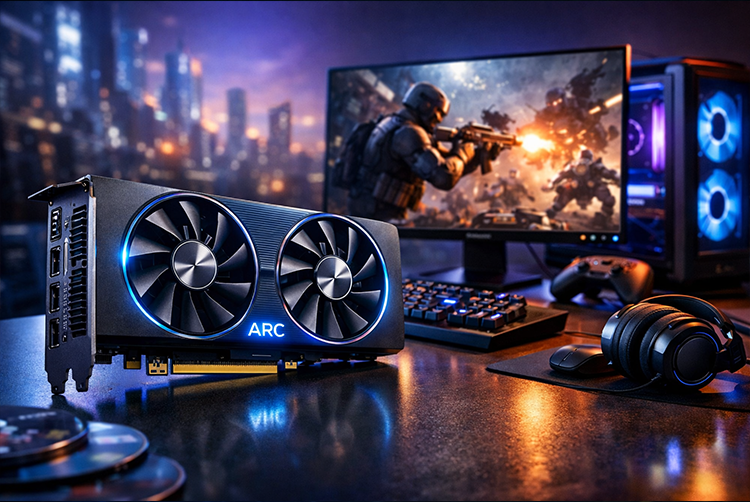
n the ever-evolving landscape of PC gaming, finding a graphics card that balances performance, price, and future-proofing can feel like a challenge. Enter the Intel Arc B570, a budget-friendly desktop GPU from Intel’s second-generation Battlemage lineup. Released in late 2024, this card has quickly gained traction among gamers looking for solid 1440p capabilities without breaking the bank. Priced around $220, it offers 10GB of GDDR6 memory and advanced features like ray tracing, making it an attractive option for mid-range builds in 2026.
Whether you’re upgrading an older system or piecing together a new rig, the B570 stands out for its efficiency and compatibility with modern titles. As games push graphical boundaries with higher resolutions and immersive effects, this GPU delivers where it counts smooth frame rates in competitive play and stunning visuals in story-driven adventures. In this deep dive, we’ll cover its specs, real-world performance, and how it fits into today’s gaming ecosystem. If you’re eyeing requirements for upcoming releases, resources like the Arc Raiders system requirements can help gauge if the B570 aligns with your setup.
The Origins and Development of Intel Arc B570
Intel’s foray into discrete GPUs began with the Alchemist series, but Battlemage codenamed for the Arc B-series represents a refined step forward. Built on TSMC’s 5nm process, the B570 features the Xe2 microarchitecture, which emphasizes energy efficiency and AI acceleration. Launched in Q4 2024 alongside its sibling, the B580, it targets the entry-to-mid-tier market, competing directly with NVIDIA’s RTX 4060 and AMD’s RX 7600.
The development focused on addressing pain points from the first-gen Arc cards, such as driver stability and Resizable BAR support. By 2026, Intel’s software ecosystem has matured, with regular updates enhancing compatibility across Windows and even some Linux environments. This makes the B570 ideal for creators and gamers alike, especially in hybrid workflows. For those optimizing older hardware, tips from guides like Fortnite lag fixes for low-end PCs show how pairing it with modest CPUs can yield impressive results.
Scalability is a key strength; the B570’s 18 Xe-cores and 144 XMX AI engines handle everything from esports to light content creation. Its 150W power draw keeps it efficient, fitting well in compact cases or upgrades without needing a massive PSU.
Key Features That Make the Intel Arc B570 Stand Out
What sets the B570 apart is its blend of modern tech at a budget price. At the core is hardware-accelerated ray tracing with 18 ray tracing units, enabling realistic lighting and shadows in supported games. While not as robust as higher-end cards, it shines in titles like Cyberpunk 2077 or Alan Wake 2, especially when combined with Intel’s XeSS upscaling technology.
The 10GB GDDR6 memory on a 160-bit bus provides 380 GB/s bandwidth, ample for 1440p textures and multitasking. This is particularly useful in multiplayer scenarios where quick loading matters think cross-platform battles in games that support it, such as checking if XDefiant is crossplay-enabled.
AI features via XMX engines boost performance in upscaling and frame generation, rivaling DLSS or FSR. The card also supports AV1 encoding for efficient video streaming, a boon for content creators using tools like OBS. Connectivity includes HDMI 2.1 and three DisplayPort 2.1 ports, ready for multi-monitor setups or high-refresh-rate displays.
Efficiency is another highlight; at 150W, it runs cooler than competitors, with models like the Sparkle Guardian OC featuring axial fans and metal backplates for quiet operation. This makes it suitable for extended sessions in demanding games, where stability is key.
Real-World Performance: Benchmarks and Gaming Insights
In 2026 benchmarks, the B570 holds its own impressively. At 1080p, it averages 70-80 FPS in titles like Baldur’s Gate 3 or Starfield, scaling up to 60+ FPS at 1440p with medium-to-high settings. Ray tracing enabled drops frames slightly, but XeSS recovers much of the performance, often matching or exceeding the RTX 4060 in rasterization.
Synthetic tests like 3DMark Time Spy place it competitively, with scores around 12,000-13,000 points. In real games, it excels in esports: Over 200 FPS in Valorant or Counter-Strike 2 at 1080p. For more demanding fare, like Diablo 4, it maintains smooth play keep tabs on Live tracker for Diablo 4 server stability to ensure online sessions run without hitches.
Paired with a capable CPU like the Intel Core i7-10700K, the B570 minimizes bottlenecks, though reviews note it performs best with mid-range processors. At ultrawide resolutions like 5120×1440, it handles lighter games well but may need settings tweaks for heavier ones. Overall, its 10GB VRAM prevents stuttering in VRAM-heavy scenarios, a common issue with 8GB cards.
Intel Arc B570 in Content Creation and Beyond Gaming
While gaming is its primary domain, the B570’s AI accelerators make it versatile for creative tasks. In Adobe Premiere Pro or DaVinci Resolve, AV1 support speeds up exports, and Quick Sync handles encoding efficiently. For 3D modeling in Blender, ray tracing acceleration aids rendering previews.
Streamers benefit from low-latency encoding, integrating seamlessly with platforms like Twitch. If you’re into cloud gaming or subscriptions, pairing it with services outlined in what Xbox Game Pass Ultimate includes expands your library without needing top-tier hardware.
Backward compatibility is strong; it runs older titles flawlessly, much like how the PS5 handles PS4 games explore can PS5 play PS4 games for console parallels. In emerging tech like VR, it supports free experiences from lists of the top 20 best free VR games in 2026, delivering immersive play at budget levels.
Comparing the Intel Arc B570 to Competitors and Siblings
Against the NVIDIA RTX 4060 ($300), the B570 offers better value with more VRAM and comparable performance in non-RT scenarios up to 27% faster than the RX 7600 in some tests. However, NVIDIA edges in ray tracing efficiency. Compared to its big brother, the B580 ($250), the B570 is about 12% slower but $30 cheaper, making it the sweet spot for budget builds.
In AMD’s camp, it rivals the RX 7600 but wins on power efficiency. For crossplay-heavy games like PUBG, hardware like this ensures smooth sessions verify is PUBG crossplay to connect with friends. Looking ahead, as architectures evolve (think AMD’s RDNA iterations), the B570’s Xe2 foundation positions it well for future updates.
In the broader market, it’s a disruptor for budget gamers, especially in regions where affordability matters. Accessories to complement it, from the 5 must-have for a pro gaming setup, can elevate the experience further.
The Broader Impact of Intel Arc B570 on the GPU Market
By bringing high-VRAM, ray-tracing-capable graphics under $250, the B570 democratizes advanced gaming. It encourages developers to optimize for Intel hardware, benefiting the ecosystem. In competitive scenes, its low power draw suits laptops and mini-PCs, expanding access.
As 2026 brings titles with demanding features, like those in Battlefield 6 PC requirements, the B570 ensures entry-level users aren’t left behind. Its influence extends to indie games and roguelikes, where performance tweaks matter check the Reverse: 1999 tier list for strategy insights that pair with efficient hardware.
In a market dominated by duopolies, Intel’s push with Battlemage fosters competition, potentially lowering prices overall. For enthusiasts, it’s a reminder that great gaming doesn’t require flagship spending.
FAQs About Intel Arc B570
What are the key specs of the Intel Arc B570?
The B570 features 10GB GDDR6 memory, 18 Xe-cores, a 160-bit bus, and 150W TDP. It’s built on Xe2 architecture with ray tracing and AI upscaling support.
How does the Intel Arc B570 perform in 1440p gaming?
It delivers 60+ FPS in most modern titles at 1440p with medium-high settings, excelling with XeSS enabled for ray-traced games.
Is the Intel Arc B570 good for ray tracing?
Yes, it supports hardware ray tracing, performing well in supported titles, though it may need upscaling for optimal frame rates compared to higher-end GPUs.
What CPUs pair best with the Intel Arc B570?
Mid-range CPUs like Intel’s 12th-gen or AMD Ryzen 5000 series work great, avoiding bottlenecks. Older ones like the i7-10700K still perform solidly.
How does the B570 compare to the RTX 4060?
It’s competitively priced with more VRAM, offering similar or better rasterization performance, but NVIDIA leads in pure ray tracing efficiency.
Can the Intel Arc B570 handle content creation?
Absolutely, with AV1 encoding and AI acceleration, it’s suitable for video editing, streaming, and light 3D work.
What games run best on the Intel Arc B570?
Esports titles like Fortnite or Destiny 2 shine, especially in crossplay modes confirm is Destiny 2 crossplay. Heavier games like The Finals benefit from its VRAM see The Finals crossplay.
