

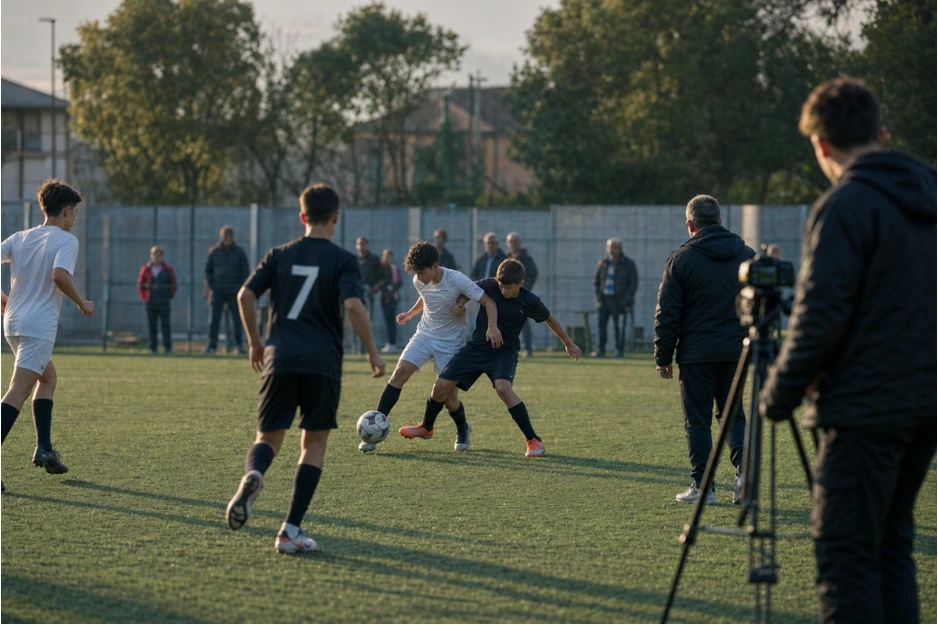
How do young footballers in Italy actually get noticed by clubs? Usually through repeated, documented performances in registered competition — not through one viral clip. Evaluators work with context: birth year, level of opposition, minutes played, position, availability. A video opens a conversation. A verifiable season is what lets somebody write a name down and plan a second viewing.
This piece is built around three things a family can genuinely influence, in the order they matter. Who watches young players in Italy, and how much any of those people can actually decide. Then the formal pathway — the FIGC youth structure and the registration rules that shape your options more than most families realise. Finally, the player package and the outreach approach that survive a phone call. The international academy narrative can wait until those three are in place.
In brief: the short version
If you read nothing else, this is the sequence that tends to work for a player based in Italy or moving there:
- Play consistent minutes in a registered, organised competition — the same league, the same role, week after week.
- Settle on one primary position and be able to describe your tasks in that role in three sentences.
- Build a one-page profile with exact competition names, age group and a direct contact, without adjectives.
- Record two or three full matches (or full halves) rather than a ninety-second compilation.
- Secure one coach reference with a reachable phone number.
- Write to a short, level-appropriate list of clubs individually, not to fifty addresses.
- Learn the registration rules that apply before and after a player’s fourteenth birthday, because they change your freedom of movement.
Who actually watches young players — and what they can decide
The word scout covers several different jobs, and confusing them wastes a lot of family energy. In many clubs the person who watches an age-group fixture is not the person who signs anyone: territorial observers tend to file reports, technical staff filter those reports against squad needs, and squad needs are rarely the same thing as pure talent. A club can be short of a left-footed centre-back born in a specific year while already carrying four creative midfielders. Around that core sit external evaluators and licensed intermediaries, who in practice often have less authority over a decision than families assume.
In brief: the person who watches you is frequently not the person who decides, and the person who decides usually needs a written, checkable reason. Most of the advice below follows from that single point.
Age changes the conversation too, though this is working practice rather than a rule published anywhere. With younger players, attention often falls on learning speed — coordination, how quickly a tactical instruction is absorbed and then applied two minutes later under pressure. Maturation makes those judgements genuinely difficult. A physically early thirteen-year-old can dominate a match while showing little that transfers; a late developer with excellent scanning can look ordinary for a whole season. As players move towards the older youth categories, the questions asked tend to get more concrete: can this player hold a role for eighty minutes against opponents who are just as quick? Neither phase is well served by a compilation of goals.
The funnel is enormous, which is why repetition beats one showcase
Some federal numbers give the problem its real shape. The FIGC’s Youth and Scholastic Sector, which promotes, organises, regulates and develops the sporting and educational activity of young male and female footballers across Italy, involves over 700,000 Under-17 athletes belonging to sports clubs — and more than 830,000 participants once all youth activity is counted. Inside that population, the most structured environment is the National Youth Championships, reserved for the Under-18, Under-17, Under-16 and Under-15 categories of professional clubs, plus Under-17 and Under-15 amateur categories, futsal and women’s categories. Those championships involve roughly 5,000 athletes a year and generate 3,496 matches.
Read the two figures next to each other and visibility stops being mysterious. Hundreds of thousands of players are visible in principle; a few thousand play in competitions a professional academy can cover systematically, season after season. What appears to narrow that gap, in most accounts of how recruitment works, is familiarity: coaches whose judgement has already been sampled, leagues whose level is known, contexts that have produced reliable reports before. A regular starter in a credible regional league, recommended by a coach a scout can phone, is often easier to assess than a player with better footage and no placeable context.
Federal governance is moving in the same direction. The FIGC has launched a technical project for Italian football intended to coordinate the bodies involved in development — coaching, youth and school football, and the Italy national teams — with President Gabriele Gravina entrusting the role of Technical Director to Maurizio Viscidi, described as having over ten years coordinating Italy’s youth teams. Within that structure the Under-14 project is presented as a link between amateur kids’ football and international representative teams from the Under-15s onward. Gravina framed the ambition as creating a proper office for Italian talent, noted that the federation, unlike other European associations, had never had a Technical Director coordinating its various bodies, and said Cesare Prandelli would support the work as an expert advisor.
The practical reading for a thirteen-year-old is straightforward. The route between grassroots and representative football is being formalised, and formal routes are normally entered through registered competition rather than through direct messages. The same caution applies to large federal events: the Grassroots Festival at Coverciano gathers over 1,000 participants with an estimated 1,500 to 2,000 parents present. Days like that are valuable for the experience and the environment; treating any single one of them as an audition is usually a mistake.
Vetting an evaluation service before you pay for anything
Because the funnel is so wide, a whole market of paid assessments, showcases and advisory sites has grown around it. Some of it is useful, particularly for late developers, players at clubs with no scouting relationships, and families relocating into Italy who do not yet know which competitive level fits. The problem is that the promises look similar from the outside, so families need a checklist rather than an impression. Five questions cover most of it:
- Who assesses, and with what qualification? Named people with a coaching or scouting background, not a generic team page.
- What is the published methodology? Which criteria, over how many sessions or matches, producing what kind of written report.
- What exactly is delivered? A structured report with role fit and a development plan is a product; exposure is not.
- What does it cost, in full? Fees, travel, accommodation, insurance, medical requirements — in writing.
- What is explicitly not promised? Any guarantee of a trial, a contract or a club placement should be treated as a warning rather than a selling point.
Run that checklist on every site you find, including the one you found first. As a practical illustration: at the time of writing, soccertalentidentification.com, one of the domains a family may come across when searching for talent identification services, returned a 500 Internal Server Error, so nothing about its methodology, pricing or intended audience could be verified from that visit. A server error says nothing about quality either way — it simply means the checklist cannot be completed yet, and an incomplete checklist is not a reason to send money or documents. Ask for the same answers by email, in writing, and keep them.
The registration rules that quietly shape your options
Due diligence on private services is only half the homework. The other half is public and often ignored: the rules that determine who a player belongs to, and for how long. Families tend to read them only after losing an argument about them.
Two points are worth knowing early. For young amateur players in Italy, clubs can only use a seasonal registration for players aged 8 to 14, after which the player is free to register with any other club at the end of the season. And when a player turns 14 while registered with a professional club, FIGC rules provide for a status known as young player of series, which binds the player to that club at least until the end of the season of his nineteenth birthday.
That asymmetry explains much of the intensity around Under-14 football. The years before fourteen are the period of easiest mobility; what follows is a commitment with real duration. Which is why a signature at fourteen deserves unhurried questions — about likely playing time, the position the club actually sees, schooling arrangements, travel, and what happens if the player does not progress as hoped — asked before anyone celebrates.
For players crossing borders, the frame widens. FIFA’s Regulations on the Status and Transfer of Players, in the January 2025 edition that includes an interim regulatory framework, contain a dedicated section on international transfers involving minors, with protection of minors treated under it. Those regulations have played a key role in the training and development of players since 2001, and they carry the financial architecture that explains why clubs invest in youth at all. Training compensation, governed by article 20 and Annexe 4, rewards clubs that invest in the training and education of young players when those players succeed in turning professional. Solidarity contribution, under article 21 and Annexe 5, returns amounts relative to fees paid in a player’s future transfers to the clubs that trained him. On 22 October 2022 the FIFA Council approved the FIFA Clearing House Regulations, covering a three-step process: identifying entitlement to training rewards, creating an electronic player passport, and transferring payments between clubs through the Clearing House entity.
None of that is trivia for a sixteen-year-old. It is the reason a developing club has a documented economic interest in a clean registration history — and a reason to be wary of anyone who treats paperwork as an obstacle to be worked around rather than as the basis of the whole system.
What evaluators look for beyond the highlights
A reel shows what a player can do once. A report describes what a player does repeatedly. Most of the qualities that fill reports happen off the ball and are therefore invisible in a compilation.
Start with game understanding. Does the player scan before receiving? Is the first touch oriented towards the next action, or does it kill the sequence? Under pressure, is the decision simple and correct, or decorative? Twenty uninterrupted minutes of match footage will usually answer those questions. Ninety seconds of goals will not.
Then there are role expectations, which differ sharply by position and are worth thinking about honestly:
- Full-back: one-on-one defending in a narrow corridor, timing of overlaps, delivery under pressure, recovery running.
- Holding midfielder: body orientation, screening passing lanes, receiving with a defender on the shoulder, switching the point of attack.
- Winger: beating an opponent in limited space, arriving in the box, tracking a runner after a turnover.
- Striker: movement inside the six-yard box, holding play, one-touch finishing, pressing angles.
- Centre-back: line management, aerial duels, passing forward into a moving target.
- Goalkeeper: positioning, distribution under pressure, command of the area.
General athleticism rarely substitutes for any of that, although acceleration over short distances, the ability to repeat sprints late in a match and overall coordination are common reference points — best interpreted against a player’s maturation rather than as fixed traits. Behavioural signals often count for more than families expect: coachability, the reaction to being substituted, communication with teammates, consistency across good and bad weeks. Underneath everything sits a quiet reliability check covering injury history, real availability, training habits and how workable the family is. A player who is excellent and unavailable is, in report language, unusable.
Build a profile someone can verify in ten minutes
All of the above has a practical consequence: the package you send should make verification easy rather than impressive. The minimum credible version is modest and unglamorous.
One page: date of birth, primary and secondary position, dominant foot, height and weight where relevant, club history with exact competition names and age groups, appearances or minutes where documentable, and a direct contact. No adjectives. Then evidence: two or three full matches, or at least full halves, with the shirt number stated, the opposition level named, and sequences left unedited. A short highlight reel can sit on top as an index — never as the only exhibit.
Trust is built by boring detail. Timestamps. One line explaining the tactical task in that specific match. The scoreline context. No music. References work the same way: a reachable phone number for a coach whose league a scout can place usually carries more weight than any self-description. If you include numbers, keep them few, defensible and explained.
You do not need expensive software for any of this. A 2026 industry overview cited examples ranging from subscription plans of roughly $32 to $162 per month up to licences around $1,800 per user per year — examples from one overview, not market benchmarks, and pricing in this category varies a great deal. They are quoted only to make the point that the tool tier a family may feel pressured to buy is largely irrelevant at this stage. A fixed camera, a wide frame, honest labelling and consistent minutes will normally take a teenager further.
Contacting clubs and trials: a practical etiquette
Recruitment cycles vary by club, so treat timing as something to ask about rather than guess. A sensible approach is to make contact well before a season’s decisions are being finalised, and to accept that messages sent in the closing weeks of a campaign often land at the worst possible moment. Keep the message short: who you are, birth year, position, current club and league, three lines on your role, one link to full-match footage, and a coach’s contact. No unrequested attachments, no childhood biography, no comparison to a professional player.
Before accepting a trial, ask four questions: which age group and squad you would train with; what type of sessions, and across how many days; who evaluates, and against which criteria; and what the costs, insurance and medical requirements are. The answers double as a filter. If they are vague or arrive reluctantly, that is information.
On intermediaries, the honest version is narrow. They can make introductions, handle documentation and negotiate terms. They cannot create talent, and they cannot manufacture a competitive level that does not exist. Written terms and full transparency on fees protect the family; unwillingness to provide either is an answer in itself.
Mistakes that get talented players ignored
- Sending only a highlight reel. With no full-match footage behind it, it can read as an attempt to hide the other eighty minutes.
- Collecting trials instead of minutes. Four trials and no settled role leave almost nothing to report on; one season as a starter leaves something writable.
- Inflating level. Describing an amateur side as an academy, or a friendly tournament as a national competition, is easy to check and expensive to repair.
- Managing availability badly: undeclared injuries, school conflicts discovered on arrival, travel plans that collapse at the last minute.
- Polishing strengths while ignoring the dull priorities — first touch under pressure, scanning, defensive transitions.
A ninety-day visibility plan
Weeks one and two are administrative and honest. Define your primary role — not three roles — assemble the one-page profile, record or obtain two full matches, and ask one coach for a reference with a contact number attached.
Weeks three to six are about playing. Track two or three performance themes rather than every touch: for a full-back, one-on-one defending and delivery under pressure; for a holding midfielder, forward passes completed against pressure. Refresh the footage as the level of opposition changes, and write the context notes as you go rather than six weeks later.
Weeks seven to ten: build a shortlist of clubs roughly one level above your current one — five, not fifty — and write to each individually with the same short structure. If you attend an event, choose one with credible opposition and treat it as a single data point, not a verdict.
Weeks eleven to thirteen: follow up once, politely. Work on the weakness your own tracking exposed. Prepare physically and tactically for the intensity of a trial session, which tends to be faster and more compressed than a league match.
Then measure the right outputs. Replies from technical staff, an invitation to be watched in a league fixture, specific feedback about your role — those indicate movement. Views, followers and generic praise do not. Progress, in scouting terms, means somebody with authority holds enough verified information to write your name down and plan a second viewing. Three actions start that process this week: fix your position, record one full match with the opposition level named, and ask a coach whose word can be checked to say what you are. If in three months more people are asking to see you again than you are asking to be seen, the plan is working.
