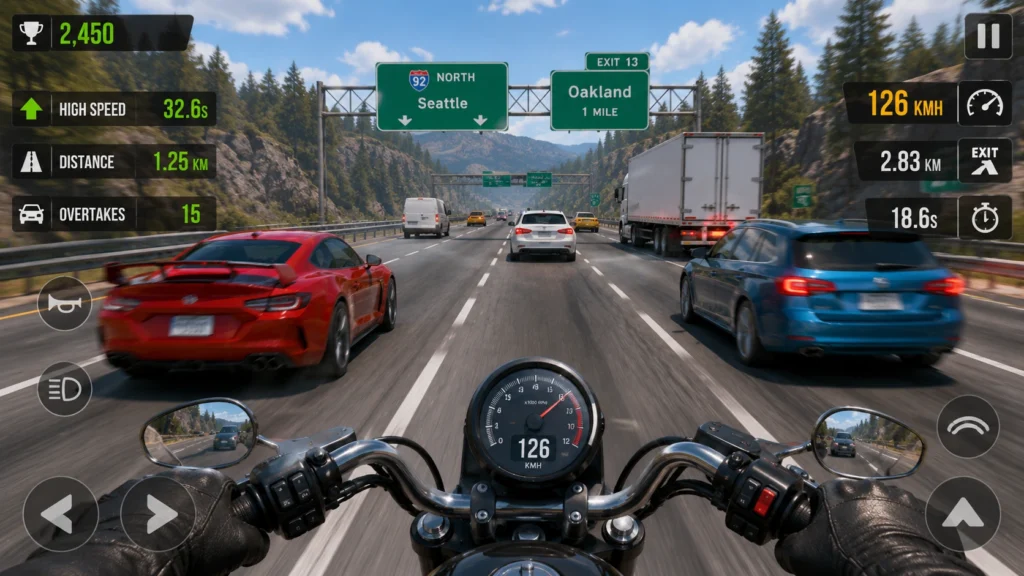
Highway Traffic looks like it shouldn’t be fun. You drive a car down a highway, you dodge other cars, and you don’t crash. That’s it. And yet the game has accumulated years of daily players on school Chromebooks, office lunch breaks, and bedroom desktops across the US precisely because the gap between picking it up and actually getting good at it is wide enough to be genuinely interesting.
Is Actually Highway Traffic Unblocked?
Yes, on the vast majority of US school and workplace networks. Highway Traffic runs in HTML5/WebGL and loads directly in a browser tab with no download, no executable, and no account required. Network content filters that block executable game files or platforms like Steam can’t flag it differently from a regular website visit.
The most reliable hosts in 2026 are FreezeNova, OnlineGames.io, ozogames, and CrazyGames, all of which pass school filters in most US districts. If one of those is specifically blocked on your network, the others almost certainly aren’t; the game is mirrored widely enough that finding an accessible version is rarely a problem.
The game is single-player only, so there’s no account needed and no multiplayer server to route around network restrictions. Just open the page and play.
If you want a broader list of games that work under the same conditions, this guide to unblocked G games covers reliable no-download options across every genre for US players on filtered networks right now.
Controls
InputAction
Up Arrow or W Accelerate
Down Arrow or S Brake
Left / Right Arrow or A / D Steer
Spacebar Nitro boost
Mobile Tap/tilt (on-screen controls)
The controls are deliberately minimal. Everything comes down to steering timing and speed management, which is where the game’s depth lives in decision-making, not in remembering a complex input set. Mobile touch controls work, though the precision you need in later traffic densities makes desktop the better choice for high-score attempts.
One physics detail that trips up new players: the game includes an inertia system. You cannot stop or change direction instantly. At high speed, a lane change takes longer to complete than it looks like it should, and braking requires genuine anticipation rather than a last-second panic press. The longer your run goes and the faster you’re traveling, the more that gap between input and response matters.
The Four Game Modes
This is the part most guides gloss over. Each mode isn’t just a difficulty variant; it rewards a meaningfully different approach.
One Way is the starting mode. All traffic moves in the same direction you do, which means cars ahead will slow down, speed up, or brake but won’t come head-on. This is where you learn the handling physics, find your preferred lane discipline, and build the scan-ahead habit without worrying about oncoming traffic. Don’t rush past One Way; the habits formed here transfer directly into the harder modes.
Two Way is the mode that generates the highest scores and the most frustration. Oncoming traffic in the opposite lane creates head-on collision risk that doesn’t exist in One Way, but driving in the oncoming lane is where the largest score bonuses live. The risk-reward is explicit: stay in your lane and survive longer, or take the wrong lane for far more points per distance traveled. Advanced players who want fast cash for car unlocks deliberately spend as much time as possible in the oncoming lane in Two Way. It takes confidence in your reaction speed to make that work consistently.
Time Attack changes the objective entirely. Instead of pure distance survival, you’re racing against a clock and near misses add time to your countdown. This creates the interesting dynamic where playing dangerously close to other cars is mechanically incentivized, since each clean near miss tops up your timer. Hanging back in clear lanes loses you time. This mode rewards the aggression that One Way punishes you for learning.
Speed Bomb is the mode that sounds gimmicky until you play it. You’re driving a vehicle rigged with a bomb that detonates if your speed drops below a threshold. The bus-from-Speed dynamic forces a minimum pace regardless of traffic density; you can’t brake your Way through a cluster of slowing cars. You have to steer around them at speed, which makes Speed Bomb one of the best modes for building the continuous-movement habit that breaks most players of their brake-first reflex.
If you enjoy this kind of scoring-heavy, obstacle-dodge driving in a browser, Drift Boss Unblocked runs on the same no-download principle with a single-input mechanic; it’s a completely different play feel but the same audience and the same school-network accessibility. And for a driving game with more of an escape and evasion angle, Escape Road City 2 is worth knowing about in the same unblocked space.
Weather Options
Three weather conditions are selectable before each run: day, night, and rain. Day is the clearest and most recommended while you’re learning the car’s handling. Night reduces visibility, which means incoming obstacles appear with less reaction time. Rain adds slick road physics on top of reduced visibility, making it the hardest environment to navigate at any speed.
Weather doesn’t affect scoring directly, but playing in rain and surviving as long as you would in clear daytime conditions is a reasonable benchmark for whether your car handling is genuinely solid or whether you’ve been coasting on good visibility.
Cars, Cash, and Upgrades
The game starts you in a basic sedan. As you earn cash from runs, which comes from distance traveled, near misses, and mode bonuses, you unlock additional vehicles across a range from standard family cars through sports cars to high-performance supercars. Trucks are also in the roster; they handle noticeably differently from cars, with more momentum and slower directional changes that require earlier steering input.
Upgrade order matters more than most players realize. Three categories are upgradable:
Handling should be upgraded first. Counterintuitively, a car that steers precisely through tight gaps survives longer and generates more near-miss multiplier income than a faster car that can’t hold its line. The point isn’t to drive faster; it’s to control where the car goes at any speed.
Braking is second priority for the same reason. Shorter stopping distances let you use the full road and correct errors without crashing.
Speed/Engine upgrades come last. Once the car responds predictably, more speed makes long runs happen faster and boosts your distance-per-session income. But more speed in an unresponsive car means you crash further from the start.
You can also change car color through the customization menu, which is purely cosmetic but doesn’t cost cash; change it whenever, and it doesn’t affect progression.
How Scoring Actually Works
The score is built from two parallel systems running simultaneously.
The first is distance. Every meter you travel without crashing adds to your total. This is the baseline: the longer you survive, the higher your base score, and the more cash your run generates.
The second is the near-miss multiplier. Passing within close range of another vehicle without hitting it counts as a near miss and briefly increases your score multiplier. Chain multiple near misses in a row, threading through a cluster of cars in quick succession, and the multiplier stacks. This is why the highest-scoring players aren’t the most cautious; they’re the ones who can sustain close-call streaks for extended runs. The risky play generates more score per distance than safe lane-keeping.
Two Way mode adds a layer: driving in the oncoming lane applies a constant point bonus while you’re in it. Combined with the near-miss multiplier from oncoming cars passing closely, Two Way runs generate significantly more cash per session than the same distance in One Way. The trade-off is obvious: crash risk goes up sharply, and one bad read of oncoming traffic ends the run immediately.
Tips That Actually Change Your Results
Look further ahead than feels natural. The instinct is to watch the car directly in front of you. Skilled play requires scanning three or four cars ahead simultaneously to identify which gap you’re going to use before you need it. By the time you react to an immediate obstacle, you’ve already lost the option of the better route ten meters ahead.
Stay in the middle lane as your default position. The middle lane gives you a lane’s worth of escape room on both sides. Driving in an outer lane cuts that buffer in half, which means one unexpected braking car ahead takes your only escape option away.
Don’t hold nitro through clusters. The instinct when traffic gets dense is to slam nitro and blast through. It usually ends the run. Nitro is most effective on clear open stretches after you’ve navigated through a cluster, letting you build speed into the next gap rather than boosting speed directly into obstacles.
Use the handbrake for sharp evasive turns. In situations where you need to change lanes more quickly than normal steering allows, the handbrake produces a faster rotation that can thread gaps normal steering would overshoot. It takes practice to control the resulting slide, but it’s a specific tool for specific moments rather than general steering.
In Speed Bomb, choose a lighter car. Heavier vehicles maintain speed momentum more but take longer to steer around obstacles at the constant pace the bomb forces. A sports car’s faster directional response handles Speed Bomb’s minimum-speed requirement without the steering delay trucks introduce.
Build your first upgrade on handling, not engine. A fast car that moves unpredictably crashes before it earns back the upgrade cost. A precise car that can be placed exactly where you want it generates far more near-miss chains over the same distance, which builds cash faster.
Frequently Asked Questions
Is Highway Traffic free?
Yes, completely free on every host. No purchases, no subscriptions.
Are there cheat codes?
No, no cheat codes exist for any version of the game. Skill and upgrade investment are the only routes to higher scores.
Can you play multiplayer?
No. Highway Traffic is single-player only. Multiplayer competition happens through leaderboard score comparison, not simultaneous play.
Does progress save between sessions?
Unlocked cars and upgrades save locally in your browser on most hosts. Clearing site data or switching browsers typically resets your garage.
What’s the best mode for farming cash?
Two Way, specifically with time spent in the oncoming lane. The point bonus from wrong-lane driving stacks with near-miss multipliers to produce the highest cash per session of any mode.
What’s the best mode for beginners?
One Way, day weather, default sedan. Learn the inertia physics before adding oncoming traffic or reduced visibility.
Does it work on mobile?
Yes, touch controls are built in, and the game is fully responsive. Desktop gives more precise steering at high speeds, but mobile is fully playable.