

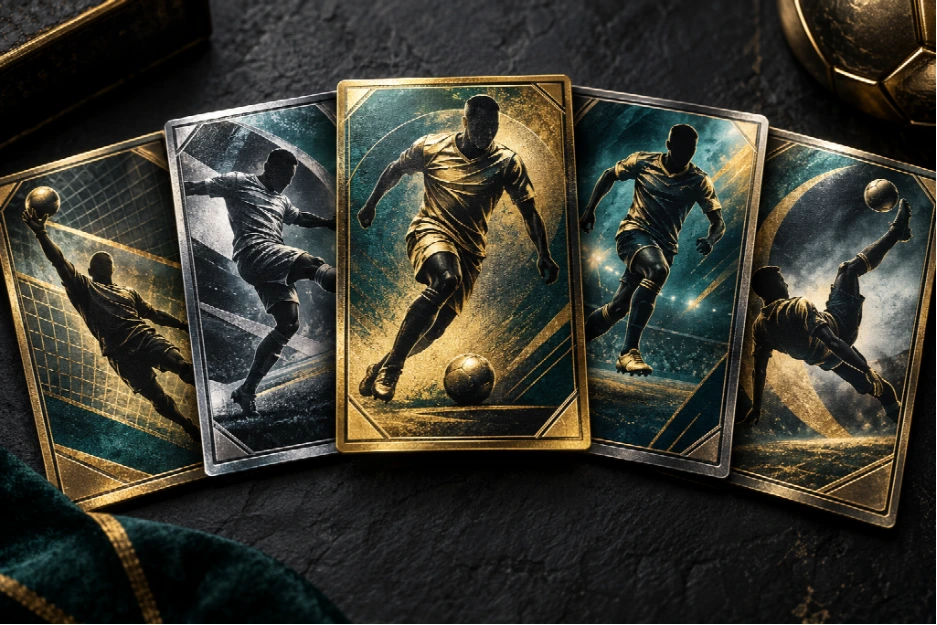
Football sticker albums have been a fixture of childhood for generations. You bought a packet, you did not get the player you wanted, you traded with someone at school who did. The mechanics were simple, tactile and unchanged for decades.
Then video games took that exact loop, moved it onto a screen, and scaled it to tens of millions of people. Card-collecting modes in football games now constitute one of the largest collecting hobbies on earth, and they run on the same three ideas: randomised packs, a rarity ladder, and the ability to trade with other collectors.
What is interesting for anyone who makes physical objects is that the influence has started flowing back the other way.
What the digital version got right
Digital card collecting solved several problems physical collecting never could.
The first is liquidity. In an album, an unwanted duplicate is worth whatever the person across the playground will give you. In a digital market with a live transfer system, every card has a visible current price and can be sold instantly. Collectors know exactly what their collection is worth at all times.
The second is condition. A physical card degrades. Corners soften, surfaces scuff, and grading a card is an entire industry built around the fact that condition is both critical and subjective. A digital card is identical to every other copy, forever.
The third is utility. A physical card sits in a binder. A digital card does something: it plays, it has stats, it changes how your team performs. That transforms collecting from an aesthetic activity into a functional one, and it is the single biggest reason the digital version grew so fast.
What it lost
It lost the object. And it turns out the object mattered more than anyone expected.
A digital card cannot be put on a shelf. It cannot be handed to someone. It cannot survive the game it lives in, and it does not: when a new edition ships each year, the previous collection is stranded. Collectors who spent a season assembling something watch it become inaccessible, not through neglect but by design.
That is a strange thing to sit with for anyone whose instinct is to keep what they collect. And it has produced a quiet counter-movement.
The maker response
Go looking and you will find a growing body of work in the maker community responding to exactly this: printable card frames and display stands, trophy replicas, stadium dioramas, tabletop football miniatures, custom shelf pieces built to hold a moment from a game that no longer exists.
It is a natural fit for printing. These are small-format, display-oriented objects with a lot of surface detail, low functional tolerance and enormous scope for personalisation. A card holder is a genuinely good first design project. A stadium diorama is a genuinely hard one.
The personalisation is the point. A mass-produced football collectible celebrates whoever the manufacturer decided to celebrate. A printed one celebrates the specific team you built, in the specific season you built it. That is not something you can buy.
Designing for the crossover
A few practical notes for anyone designing in this space.
Scale to the card, not to the design. Trading card dimensions are standardised and the tolerances are tighter than they look. A holder that is half a millimetre narrow is unusable, and a holder half a millimetre wide lets the card slide. Print a test coupon before committing to a full sleeve.
Design for layer direction. Thin display frames printed flat are fragile along the layer lines and snap at the corners. Printing them upright costs supports but survives handling.
Leave room for finishing. Football collectibles read as premium when they are painted or foiled, and both need a surface that has been designed with a little relief rather than a flat face.
And be careful with likeness and badges. Club crests and player likenesses are protected. Generic silhouettes, abstract kit patterns and custom nameplates keep a design shareable; a recognisable crest does not.
Where the two hobbies meet
The collectors driving this crossover tend to be doing both at once. They assemble a squad digitally through the season, following the market, tracking which cards are rising, and building around whichever FC 27 Players suit the way they actually play. Then they print something to mark it.
That combination is more coherent than it first sounds. The digital side supplies the narrative, the competition and the constant churn. The physical side supplies permanence. One is a season, the other is a shelf.
For the maker community it represents a genuinely large, genuinely underserved audience. Tens of millions of people spend a season building something they cannot keep. Giving them a way to keep a piece of it is a design brief with real demand behind it, and almost none of it has been filled yet.
