
Choosing the right RAM is a critical decision when building or upgrading a gaming PC. One of the most searched questions right now is DDR4 vs DDR5 for gaming and for good reason. With DDR5 becoming more common on newer platforms, gamers want to know whether the performance gains are real or just marketing hype.
In this guide, we’ll compare DDR4 and DDR5 from a real-world gaming perspective, covering performance, pricing, compatibility, future-proofing, and who should choose what. Internal references to related hardware and performance topics are included naturally to help you plan a balanced build.
What Is DDR4 and DDR5 Memory?
DDR4 has been the standard gaming memory for nearly a decade. It’s widely supported, affordable, and extremely stable. Most gaming systems released before the latest CPU generations are built around DDR4.
DDR5 is the next-generation RAM designed for modern CPUs. It introduces higher bandwidth, improved power efficiency, and better scalability for future workloads. While it looks superior on paper, gaming performance depends heavily on how memory interacts with the CPU, motherboard, and GPU.
DDR4 vs DDR5: Gaming Performance Comparison
Average FPS in Modern Games
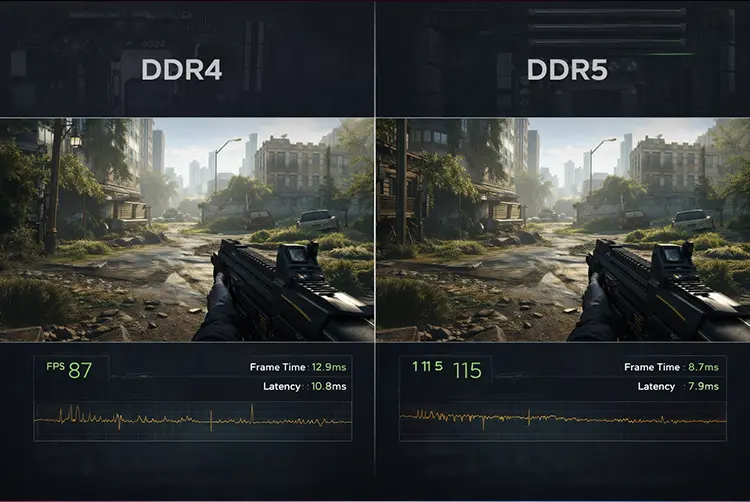
In most AAA and competitive games, the average FPS difference between DDR4 and DDR5 is relatively small. At 1080p and 1440p, DDR5 can provide slight gains usually between 3% and 8% especially in CPU-intensive titles like open-world games and esports shooters.
At higher resolutions such as 4K, GPU performance becomes the main bottleneck. In these cases, DDR4 and DDR5 perform almost identically, making RAM choice far less critical than your graphics card or VRAM capacity.
If you’re gaming at 4K, understanding how VRAM impacts performance matters more than whether you choose DDR4 or DDR5.
Minimum FPS and Frame Stability
Where DDR5 starts to show an advantage is in minimum FPS and frame consistency. Faster memory bandwidth helps reduce frame drops in:
Open-world games
Strategy and simulation titles
Multiplayer games with large maps
That said, a high-quality DDR4 kit with optimized timings can still deliver very smooth gameplay, especially when paired with a well-balanced CPU setup.
Platform Compatibility: DDR4 vs DDR5
One of the biggest deciding factors is platform support.
DDR4 is compatible with older and many mid-range gaming CPUs.
DDR5 is required for most newer-generation platforms.
If you’re choosing between CPUs, your memory decision is often made for you. For example, when deciding between AMD or Intel for gaming, many newer CPUs are optimized specifically for DDR5 performance.
Similarly, motherboard selection plays a major role. If you’re shopping for a new board, guides focused on best gaming motherboards can help determine whether DDR4 or DDR5 support makes more sense for your build.
Price and Value for Gamers
DDR4 Pricing
DDR4 remains significantly more affordable. You can buy high-speed DDR4 kits at lower prices, making it ideal for:
Budget builds
Mid-range gaming PCs
Upgrades on existing systems
DDR4 also benefits from years of optimization and stability improvements.
DDR5 Pricing
DDR5 prices have dropped compared to early adoption, but it’s still more expensive than DDR4. You’re paying for:
Higher bandwidth
Better future compatibility
Improved efficiency on newer platforms
If you’re already investing in high-end components such as flagship GPUs or planning a future-focused PC build for upcoming games like GTA 6 DDR5 becomes easier to justify.
Power Efficiency and Thermals
DDR5 is more power-efficient thanks to onboard power management. This results in:
Slightly lower overall system power draw
Better stability under heavy loads
Improved thermal behavior in long gaming sessions
For most gamers, the difference won’t be noticeable, but it does help with system longevity and consistency especially in compact or airflow-restricted builds.
Overclocking: DDR4 vs DDR5
DDR4 has a mature overclocking ecosystem. Many kits are well-documented, stable, and easy to tune. DDR5 offers higher frequency headroom, but tuning it can be more complex. Overclocking benefits are more noticeable in productivity tasks, while gaming gains remain moderate unless paired with a high-end CPU. If you enjoy tweaking hardware for performance, DDR4 is simpler, while DDR5 rewards advanced tuning on newer systems.
Future-Proofing Your Gaming PC
If you plan to keep your system for several years, DDR5 offers better long-term value. Upcoming games and engines will increasingly take advantage of higher memory bandwidth, especially as CPUs evolve. Gamers investing in next-generation GPUs—such as those compared in RTX 5090 vs AMD Radeon RX 7900 XTX will benefit more from DDR5 over time as system demands grow. However, future-proofing only matters if the rest of your system is also modern. DDR5 alone won’t compensate for an outdated CPU or GPU.
Who Should Choose DDR4?
DDR4 is the better choice if:
You’re upgrading an existing system
You’re building a budget or mid-range gaming PC
You mainly play at 1440p or 4K
You want maximum value per dollar
DDR4 still delivers excellent gaming performance and remains a smart option in 2026.
Who Should Choose DDR5?
DDR5 makes sense if:
You’re building a brand-new system
You’re using the latest CPU platforms
You play CPU-heavy or competitive games
You want better long-term compatibility
If your goal is a modern, high-performance gaming rig, DDR5 aligns better with current and future hardware trends.
DDR4 vs DDR5 for Gaming – Quick Comparison Table
| Feature | DDR4 RAM | DDR5 RAM |
|---|---|---|
| Launch Era | Mature & widely adopted | New-generation memory |
| Base Speed Range | 2133–3200 MT/s | 4800–6400+ MT/s |
| Real-World Gaming FPS | Excellent for most games | Slightly higher minimum FPS |
| Frame Stability | Very stable with tuned timings | Better lows in CPU-heavy titles |
| Best Resolution Impact | 1440p & 4K gaming | 1080p high-refresh esports |
| Latency | Lower latency (CL values) | Higher latency, balanced by bandwidth |
| Overclocking Ease | Easier & well-documented | More complex but higher ceiling |
| Power Efficiency | Standard DIMM power control | On-module power management |
| Platform Support | Older & mid-range CPUs | Latest Intel & AMD platforms |
| Motherboard Cost | Lower overall platform cost | Higher board + RAM cost |
| Future-Proofing | Limited long-term headroom | Better support for upcoming games |
| Ideal Use Case | Budget & mid-range builds | High-end & new PC builds |
What This Table Means for Gamers
DDR4 remains the best value choice for players focused on GPU-bound gaming, especially at 1440p and 4K where memory speed matters less than VRAM and GPU power.
DDR5 shines in CPU-intensive workloads, open-world titles, and competitive esports where smoother frame delivery and minimum FPS matter more than raw averages.
DDR4 vs DDR5 for Gaming: Final Verdict
For most gamers, DDR4 is still more than enough and offers outstanding value. DDR5 does provide advantages in bandwidth, efficiency, and minimum FPS, but the difference isn’t dramatic unless you’re using the latest CPUs and chasing every possible frame.
In short:
DDR4 = best value and proven performance
DDR5 = better future-proofing and modern platform support
Your final decision should depend on your budget, platform choice, and upgrade plans—not marketing alone.
FAQs
Does DDR5 increase FPS in games?
Yes, but usually by a small margin. Most games see minor gains in minimum FPS rather than large average FPS improvements.
Is DDR4 still good for gaming in 2026?
Absolutely. DDR4 remains a strong choice for gaming, especially for mid-range and GPU-focused builds.
Is DDR5 worth it for competitive gaming?
DDR5 can help with frame consistency and minimum FPS in esports titles, but fast DDR4 kits still perform very well.
Can I use DDR4 and DDR5 on the same motherboard?
No. Motherboards support either DDR4 or DDR5, not both.
Should I upgrade from DDR4 to DDR5 just for gaming?
If your current system performs well, upgrading RAM alone is usually not worth the cost. DDR5 is best when building a new system.