

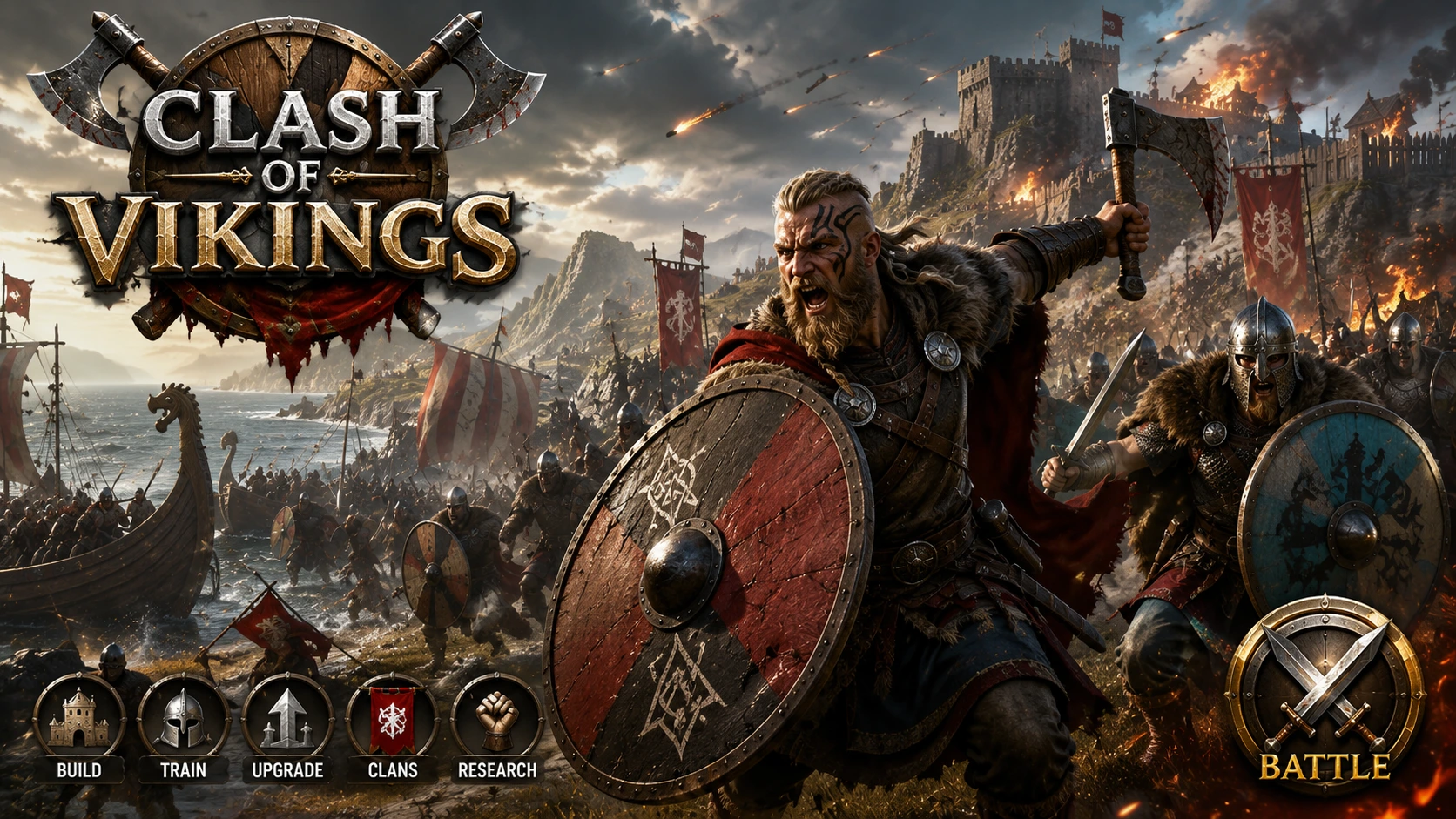
Clash of Vikings is a free browser-based card strategy game inspired by Clash Royale, where you build an 8-card Viking deck, spend regenerating elixir to deploy troops and spells, and try to destroy more enemy towers than your opponent in a fast 3-minute match. Available on CrazyGames, HahaGames, Lagged, and MSN Games — no download, no account, playable on any device right now. This guide covers every mechanic, the best deck-building strategy, elixir management, and the specific tips that win matches when the clock runs out.
What Is Clash of Vikings?
Clash of Vikings is a real-time card battle game built around quick strategic decisions under a strict 3-minute timer. Both players control a base with three structures — two side towers and a main castle keep — split by a river running through the middle of the map.
You deploy Viking units and spells by spending elixir, a resource that regenerates automatically up to a cap of 10. Units march toward enemy towers on their own once placed. Spells deal burst damage or apply special effects. Whoever destroys more towers when time runs out wins. If it’s tied, sudden death begins — first tower destroyed ends it.
The game has PvE mode against 10 distinct AI opponents and full PvP matchmaking against global players online. You can also challenge friends directly through the invite system.
If medieval browser combat is your thing, War the Knights covers similar territory with direct third-person Viking combat rather than the card layer — a good companion game to know about. And for a broad list of strategy and battle games that work unblocked, this guide to unblocked G games covers the full range.
How to Play Clash of Vikings
Setting Up Your Deck
Before every match, Clash of Vikings gives you a deck of 8 cards. The default deck is ready to use immediately. To customize it, click the card icon in the lower right corner of the start screen — this opens your full card collection where you can swap any card in or out, keeping a total of exactly 8 in your active deck at all times.
Each card shows its elixir cost. Before you hit Battle, check the cost distribution across your deck — a deck full of expensive cards will leave you sitting with empty elixir while the opponent floods the map with cheap troops.
Deploying Units in Battle
Units are deployed by dragging a card from the bottom of your screen onto the battlefield. On mobile, tap and drag. You can only place cards on your side of the river — not across it. Once deployed, troops automatically march toward the nearest enemy tower and engage anything they encounter.
The bridge crossing point is the chokepoint of every match. Troops can only cross the river at the bridge, which concentrates combat into predictable lanes. Smart players time their deployments to either push through the bridge or intercept the enemy’s crossing attempt.
Winning the Match
Three ways to win in Clash of Vikings:
- Destroy the enemy keep — immediate win regardless of tower count
- Hold more towers at the 3-minute mark — standard win condition
- Destroy the first tower in sudden death — tiebreaker if towers are equal at time’s end
Clash of Vikings Card Types Explained
Troops — The Backbone of Your Clash of Vikings Deck
Troops are the standard unit cards. They vary in health, damage, movement speed, and elixir cost:
- Swordsmen — Cheap, fast, good for swarms and distracting expensive enemy units
- Archers — Ranged damage dealers that attack from behind your frontline troops
- Giants — High health tanks that absorb damage and let other units attack safely behind them
- Raiders — Fast-moving aggressive units ideal for quick pushes into enemy territory
Heroes — Elite Clash of Vikings Units
Heroes are premium cards with higher health pools, special skills, and greater impact per card. They cost more elixir but can anchor an entire push or shut down an enemy advance on their own. Use them as the centerpiece of a combo rather than dropping them alone.
Spells — Clash of Vikings Game-Changers
Spells don’t deploy a unit — they apply an instant effect to the battlefield:
- Burst damage spells — Deal direct damage to a zone, ideal for clearing swarms or hitting a tower directly
- Chaos — Relocates all units on the battlefield randomly, useful for scrambling an organized enemy push
- Magic — Converts an enemy unit to fight on your side — the highest-impact spell when used correctly
- Support spells (Cheers, Flowers) — Situational buffs that provide healing or stat boosts
For a strategy game with similar depth in unit abilities and counters, Front Wars is worth knowing different visual style but the same unit-matchup and lane-control thinking applies.
Elixir Management in Clash of Vikings
Elixir is the most important resource in Clash of Vikings. Everything else follows from how well you manage it.
The Elixir Rules
- Maximum cap: 10 elixir
- Regenerates automatically throughout the match
- Cards cost between 2–7+ elixir depending on type
- Final 60 seconds: elixir regenerates at 2× speed — this is when the real battle happens
How to Use Elixir Efficiently
Never let elixir sit at 10. A full bar means you’re wasting regeneration — that’s free resources thrown away. Keep spending to keep the bar moving.
Keep 3–4 elixir in reserve. Not having enough elixir to respond when the enemy makes a sudden push is how most matches are lost. A cheap troop dropped at the right moment stops a push that would have taken two towers.
Don’t dump everything early. The first two minutes are the economy phase. Spend conservatively, defend efficiently, and build toward the final minute.
Dominate the final 60 seconds. Double elixir is when Clash of Vikings matches are decided. Every card you’ve held back, every elixir-efficient defense you ran in the first two minutes — it all converts into overwhelming pressure in the last minute. Players who go all-out from the start are out of options when double elixir hits.
Deck Building Strategy for Clash of Vikings
Balance Your Elixir Curve
A well-built Clash of Vikings deck has a mix of costs — some cheap cards (2–3 elixir) for fast response and counterpushing, some mid-cost units (4–5 elixir) for steady pressure, and one or two high-cost payoff cards (6–7 elixir) for final-minute pushes.
A deck of all expensive cards starves you in the early game. A deck of all cheap cards lacks the damage needed to break through towers in the final push.
Include at Least One Spell
Spells are the swing factor in Clash of Vikings. A well-timed damage spell can clear a swarm that would have otherwise wiped your push. Chaos or Magic used at the right moment can completely reverse momentum. Every strong deck carries at least one.
Pair Tanks with Ranged Support
The most reliable push structure in Clash of Vikings: one high-health unit (Giant or Hero) at the front to absorb hits, with archers or a ranged troop behind dealing damage. The tank takes the tower hits while the ranged units destroy it. Sending either type alone is far less effective.
Have a Cheap Counter Card
Every deck needs at least one 2–3 elixir card specifically for defending against sudden pushes without draining your bar. Spending 6 elixir to defend a 2-elixir enemy swarm is a losing trade. A cheap card that handles cheap threats keeps your elixir advantage intact for your own pushes.
Clash of Vikings Map and Lane Strategy
The river divides the Clash of Vikings battlefield, and the bridge is the only crossing point. This creates specific strategic patterns worth knowing:
Luring troops to your side. If the enemy sends a strong push, deploy a cheap unit near your side of the bridge. Enemy troops will target that unit, pulling them into range of your tower’s own attacks. You spend 2 elixir to neutralize a 6-elixir push — that’s the most efficient trade in the game.
Counterpushing with survivors. When your defensive troops kill the enemy’s attacking units and survive, they automatically continue pushing toward enemy territory. Use that moment. Drop additional units to support the surviving counterpush — this is when you take towers.
Splitting lane pressure. Deploying units on opposite sides of the map forces the opponent to respond to two threats simultaneously. If their answer costs more elixir than your split costs, you’re winning the economy battle.
Tips to Win at Clash of Vikings
Read the opponent’s deck in the first 60 seconds. Every card they play in the early game is a card you now know is coming back later. By the time double elixir starts, you should have a mental model of what’s in their hand.
Spell only when hitting multiple targets. Dropping a spell on a single troop is usually a losing elixir trade. Wait until a cluster of enemy units is grouped — then a single spell does 3–4 cards’ worth of work.
Defend first, push second. The counterpush — letting your defensive troops march forward after successfully defending — is more efficient than building a fresh push from scratch. You’ve already paid the elixir for those troops. Let them do double work.
Save Magic spell for the right moment. Converting an enemy Hero or Giant to your side mid-push doesn’t just remove a threat — it adds that threat to your own push simultaneously. The swing value is enormous. Don’t waste it on a cheap unit early.
In sudden death, one cheap unit wins. If the match goes to sudden death tied on towers, whoever gets a unit across the bridge first often wins. Keep 2 elixir ready for that moment and send the fastest unit you have the instant the timer hits zero.
Clash of Vikings Game Modes
| Mode | Description |
|---|---|
| vs AI | 10 opponents with distinct strategies and increasing difficulty |
| Online PvP | Matchmaking against global players |
| vs Friend | Direct invite to play someone specific |
Start with AI mode to test deck compositions and learn how different card types perform before entering PvP matchmaking.
Frequently Asked Questions About Clash of Vikings
Is Clash of Vikings free to play?
Yes — completely free on every platform that hosts it. CrazyGames, HahaGames, Lagged, MSN Games, and 1games.io all carry it at no cost with no account required.
How many cards are in a Clash of Vikings deck?
Each Clash of Vikings deck contains exactly 8 cards. You can swap cards from your full collection at any time outside of a match, but the in-battle deck is always 8.
What happens if Clash of Vikings ends in a tie?
If both players have the same number of towers standing when the timer reaches zero, sudden death begins. The first player to destroy any enemy tower in sudden death wins the match.
Can you play Clash of Vikings on mobile?
Yes. Clash of Vikings works in mobile browsers on iOS and Android. Tap and drag cards onto the battlefield. The CrazyGames review notes the game feels particularly natural on mobile.
What is the best strategy for the final minute in Clash of Vikings?
Double elixir regeneration starts in the final 60 seconds. The best approach is to have 6–8 elixir saved at that moment and immediately launch a full push with your most expensive combo — tank at front, ranged support behind, spell ready to clear defenders.
How does the Clash of Vikings elixir system work?
Elixir regenerates automatically throughout the match up to a cap of 10. Each card costs a set amount of elixir to deploy. In the final 60 seconds, elixir regeneration doubles. Efficient elixir spending — defending cheaply and spending at the right moments determines most match outcomes.
What is the difference between Troops and Heroes in Clash of Vikings?
Troops are standard units with regular health and no special abilities. Heroes are premium elite units with higher health, special skills, and greater individual impact. Heroes cost more elixir but can anchor a push or shut down an enemy advance on their own.
