

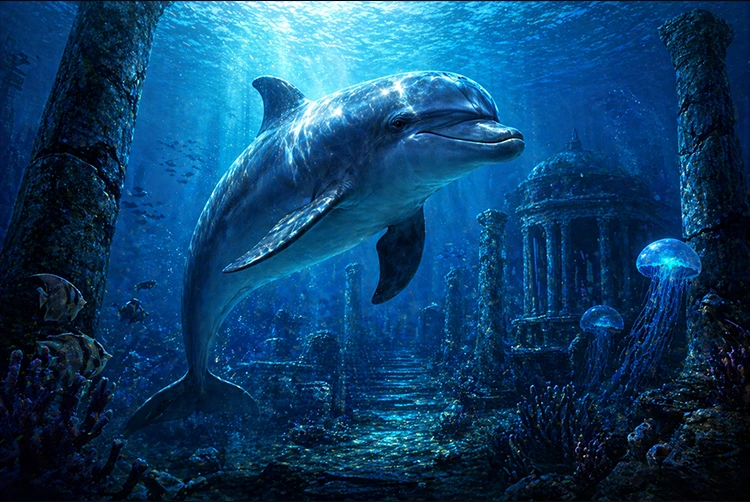
Ecco the Dolphin is one of the most singular games in the history of Sega — a 1992 side-scrolling action-adventure that begins with a dolphin leaping from the water with his pod and ends, many confusing and terrifying hours later, with that same dolphin fighting alien queens on another planet. It looks like a cute ocean exploration game. It plays like a cryptic, brutally difficult atmospheric horror with a haunting soundtrack and science-fiction lore deep enough to fill several novels.
More than three decades after its Genesis debut, Ecco is back. On April 22, 2026 Earth Day developer A&R Atelier and Sega officially announced Ecco the Dolphin: Complete, a new collection including every classic version of the original game and its sequel, plus a brand-new contemporary Ecco title built by the original development team. The franchise that defined a generation of Sega gaming is returning in the hands of the people who created it.
For more deep dives into classic games with devoted cult fanbases and complex lore, our top 25 best RPG games and our breakdown of the best free games to play right now cover a wide range of games worth exploring after this one.
Where Ecco the Dolphin Came From
The Business Context — Nintendo vs. Sega
The original Ecco the Dolphin exists partly because of a competitive crisis. In the early 1990s, Capcom signed an exclusivity deal with Nintendo that prevented Sega’s Genesis console from carrying two of the era’s most popular arcade titles: Street Fighter and Final Fight. Sega needed compelling, console-exclusive content to compete.
The result was a concerted push for original games that were different from anything Nintendo offered — games that couldn’t be made for the SNES. Ecco the Dolphin was one of the flagships of that strategy: a unique, atmospheric, technically impressive title that no one else was making, from a developer with a creative vision that didn’t fit into any established genre.
Ed Annunziata and the Hungarian Development Team
Ecco was created by Ed Annunziata, an American game designer who envisioned and conceived the project. The actual development was handled by Novotrade International (later renamed Appaloosa Interactive), a Hungarian studio founded in 1983 — meaning Ecco the Dolphin was produced almost entirely by a Hungarian team, originally with the European market in mind.
Lead programmers László Szenttornyai, József Molnár, and Zsolt Balogh built the engine that would make Ecco feel unlike anything else on the Genesis. The games are noted for the “pacifist nature” of their design philosophy, described as common in Hungarian game development of the era Ecco is a game where the protagonist doesn’t want to fight, avoids confrontation when possible, and survives through intelligence and speed rather than aggression.
Annunziata’s creative process was intensely personal. To guide the soundtrack’s feeling, he played the music team songs by Pink Floyd — specifically from Wish You Were Here and A Momentary Lapse of Reason — to convey the atmospheric, melancholic, and cosmic tone he wanted. The penultimate level of the final game is titled “Welcome to the Machine,” directly named after the Pink Floyd track that inspired it.
Before settling on dolphins as the protagonist, Annunziata carried out extensive research on marine life and was particularly influenced by Hank Searls’ novel Sounding, which detailed how dolphins use echolocation. That research shaped not just the story but the gameplay mechanics themselves — Ecco’s signature “sonar” ability for communication and puzzle-solving comes directly from real dolphin biology.
Ecco the Dolphin (1992) — The Original Game
What Kind of Game Is It?
Ecco the Dolphin is a side-scrolling action-adventure game with Metroidvania-style structure — players explore interconnected environments, gradually unlock new abilities and knowledge, and must backtrack to previously visited areas with new tools. The “combat” is minimal: Ecco can ram enemies at high speed, building velocity by tapping a button to swim faster, and maintaining it by holding it down.
But the game is far more about navigation, puzzle-solving, and survival than fighting. Ecco must surface regularly to breathe — running out of air or health both kill him, creating a constant dual-pressure system. Many enemies can’t be reasonably fought and must be evaded. The ocean is beautiful and full of wonder, and it is also trying to kill you constantly.
The difficulty is legendary. Ecco the Dolphin is widely regarded as one of the most brutally challenging games on the Sega Genesis — not through cheap mechanics but through its insistence on offering almost no guidance, cryptic puzzle design, and levels that require precise execution with minimal checkpoints.
The Story — Starting Innocent, Ending Cosmic
The game opens with one of gaming’s most disarming bait-and-switches. Ecco is swimming with his pod on a calm, sunlit day. A cheerful jumping competition begins. And then a massive storm appears from nowhere, a roaring vortex descends, and every living thing in the ocean — every fish, every whale, every member of Ecco’s pod — is ripped away and vanished. Ecco alone survives, left floating in an empty, silent sea.
What follows is a journey that begins as a search for his missing family and becomes something far stranger. The scattered lore, communicated through brief interactions with other marine animals and through ancient glyphs found carved into underwater ruins, gradually reveals the truth:
The Vortex are an extraterrestrial species that returns to Earth every 500 years to “harvest” the ocean — stripping it of marine life as food. They have done this repeatedly throughout Earth’s history. The humans of Atlantis, thousands of years ago, made contact with them and tried to resist. They failed. Before humanity vanished from Earth, an Atlantean named Cassandra left behind a series of glyphs — messages for whatever creature might eventually find them — warning of the Vortex and pointing toward the possibility of resistance.
That creature is Ecco.
To defeat the Vortex, Ecco must travel through time to the prehistoric era, interact with the ancient entity known as the Asterite — a cluster of ancient orbs with vast knowledge — and gather the tools he needs. He eventually reaches the Vortex homeworld itself, fights his way through alien architecture that looks like something out of H.R. Giger’s portfolio, and confronts the Vortex Queen.
The final boss fight is brutal, iconic, and genuinely terrifying. When the Queen is defeated, she spits out Ecco’s pod, and the dolphins escape back to Earth. The journey is over.
The Lore That Didn’t Make It Into the Game
In interviews, Annunziata has revealed far more of Ecco’s backstory than the game itself ever communicates. The Atlantean civilization, Cassandra, the deep history of the Vortex’s relationship with Earth, the meaning of the star pattern on Ecco’s forehead — these elements exist in Annunziata’s notebooks and discussions but were barely surfaced in the actual gameplay due to the limitations of early 1990s game design and the console’s constraints.
One writer theorized that even the name “ECCO” might reference the Earth Coincidence Control Office (E.C.C.O.) from the writings of dolphin researcher John C. Lilly, who was known both for his work with dolphins and for his writings about an alien intelligence he believed was guiding events on Earth. Whether intentional or not, the connection fits the game’s themes almost perfectly.
Michael Jackson reportedly played Ecco the Dolphin. Annunziata has claimed Jackson “beat it,” which, given the game’s reputation for brutal difficulty, is either testament to Jackson’s gaming skill or an extraordinary piece of apocrypha.
Where to Play It Now
Ecco the Dolphin has been rereleased across multiple platforms over the decades:
- Sega Genesis Mini (cartridge version on Mini 1; Sega CD version on Mini 2)
- Steam (PC)
- Xbox Live Arcade (legacy)
- Nintendo Virtual Console (legacy)
- Sega Genesis Collection on PS2 and PSP
- Nintendo 3DS (Virtual Console)
- iOS (legacy)
The Sega CD version is widely considered the definitive version of the original game, featuring redesigned and new levels plus a completely different soundtrack composed by Spencer Nilsen — atmospheric, New Age ambient music that replaced the Genesis FM synthesis sounds with something closer to a genuine underwater soundscape.
The Complete Franchise All Ecco Games
Ecco: The Tides of Time (1994)
The direct sequel continued Ecco’s story immediately after the events of the original. The Vortex Queen survived her defeat and followed Ecco back to Earth, where she killed the Asterite and began rebuilding her species. Ecco — now robbed of the powers the Asterite had granted him — must confront her again.
Tides of Time introduced time travel as a core narrative and gameplay element, sending Ecco to the prehistoric past and two possible versions of the future: one where dolphins have evolved to fly through the skies via internal helium sacs, and one where the Vortex have consumed the planet entirely and converted it into a mechanical feeding machine.
The game expanded the scale, the lore, and the emotional stakes of the original. The music on the Sega CD version — again composed by Spencer Nilsen — is widely regarded as one of the finest soundscapes ever produced for a video game.
The ending is deliberately ambiguous and haunting: after seemingly destroying the Vortex Queen once and for all, Ecco uses the Time Machine rather than destroying it, and vanishes into an unknown era.
Ecco Jr. (1995)
A gentle departure from the mainline series, Ecco Jr. was designed specifically by Annunziata for young children — partly as a gift for his daughter. It is rated E for Everyone by the ESRB, features no enemies, and replaces the cryptic difficulty and science-fiction horror with accessible ocean exploration and educational marine life content.
Players can switch between Ecco and two other marine animals, completing simple puzzles and interacting with friendly sea life. A Parent’s Menu lets guardians adjust difficulty or select specific levels. The final level involves finding Big Blue, a famous whale, by singing to him until he surfaces.
Ecco Jr. has its own charm as a design exercise: Annunziata proving that the ocean world he built for the original games could be repurposed as a purely joyful space rather than a threatening one.
Ecco the Dolphin: Defender of the Future (2000)
The franchise’s only 3D entry was developed for the Sega Dreamcast (and later PS2), but notably without Annunziata’s involvement. A different studio, Appaloosa Interactive (the renamed Novotrade), handled development under Sega’s direction.
Defender of the Future reimagined the Ecco mythos in an alternate Earth premise, shifting the tone significantly from the cryptic cosmic horror of the originals toward a more conventional adventure game structure. The game received generally positive reviews for its visuals and sense of exploration, but fans of the original games often distinguish it as a divergent entry — narratively separate from Annunziata’s canonical 2D games.
A sequel to Defender of the Future was in development in 2001 but was cancelled due to the decline of the Dreamcast platform.
The Music of Ecco the Dolphin — A Separate Legacy
Ecco’s music has a cultural life entirely independent of the games themselves. The Sega CD soundtracks composed by Spencer Nilsen for both the original and Tides of Time are regularly cited as some of the finest music ever written for a video game — not just for their era, but in absolute terms.
Nilsen’s approach was ambient, atmospheric, and genuinely aquatic: synthesized tones that evoked pressure, depth, and isolation. The 1996 compilation album Ecco: Songs of Time brought both soundtracks together and was distributed as a standalone CD.
The music’s influence extended in an unexpected direction. Vaporwave artists and ambient musicians have cited Ecco’s soundtrack — particularly the Sega CD compositions — as a formative influence. Chuck Person’s Eccojams Vol. 1 (2010), an early and hugely influential vaporwave release, took its title directly from the game, processing pop songs into the kind of disorienting, melancholic loops that the game’s atmosphere evokes.
The Genesis version’s FM synthesis soundtrack, composed primarily by Magyari András, has its own admirers for the distinctly hardware-specific sound it achieved — the low, pulsing tones that made the ocean feel ancient and alien in a way only the Sega Genesis FM chip could produce.
Why Ecco the Dolphin Is So Hard
The difficulty of the original Ecco the Dolphin is not incidental — it’s intrinsic to the game’s design philosophy and is part of what makes it culturally significant.
Ecco offers almost no guidance. The game tells you virtually nothing about its objectives, its world, or how to progress. You communicate with other dolphins by pressing a button near them, and they offer cryptic fragments of information rather than clear directions. The glyphs inscribed on ancient ruins offer more context but must be found and deciphered. Players spent hours — sometimes days — wandering underwater environments trying to figure out what they were supposed to do next.
The ocean itself is an unfair adversary. Enemies respawn. Air management is constant. Some passages require precise timing that the controls don’t easily facilitate. The “Welcome to the Machine” level — named, again, after the Pink Floyd song — is one of the most notoriously difficult levels in 16-bit gaming, a lengthy gauntlet through alien infrastructure that punishes every mistake by sending players back to the beginning.
This difficulty wasn’t a failure of design. It created the feeling that Ecco was genuinely alone in an incomprehensible world — that the ocean was vast and indifferent and dangerous. Players who persisted did so because the atmosphere and mystery compelled them forward despite the punishment.
The 2026 Revival — Ecco the Dolphin: Complete
The Road Back
After leaving Sega in 1997, Annunziata spent years trying to return to the franchise he created. In 2013, he attempted to crowdfund a spiritual successor called The Big Blue — but without the rights to the Ecco name, and the campaign was ultimately unsuccessful.
In 2016, Annunziata settled a lawsuit with Sega regarding the intellectual property rights to the franchise. That settlement appeared to open a path back to Ecco, and in May 2025, he confirmed in an interview that a new Ecco game was in development alongside remasters of the original and Tides of Time.
The April 2026 Announcement
On April 22, 2026 — Earth Day — A&R Atelier (the studio Annunziata founded specifically for this project, based in Half Moon Bay, California) officially announced Ecco the Dolphin: Complete alongside Sega.
The collection’s ambitions are significant:
Every Version of the Classics: Ecco the Dolphin: Complete includes all versions of both the original game and Tides of Time — the 8-bit Master System editions, the 16-bit Genesis/Mega Drive versions, and the enhanced Sega CD editions — preserved in their original form and freely explorable.
A Brand-New Contemporary Game: Alongside the classics, a new Ecco game built for modern platforms is included, described as an extension of the franchise’s journey into the present era that weaves the history of the series into a unified experience.
Made by the Original Team: The project is built by original members of the Ecco development team, reunited after more than 30 years, including Annunziata alongside original composers, artists, and programmers. The announcement stated explicitly: “No one else can make this game. This is not an outside studio’s interpretation.”
Modern Features: The collection adds speedrunning support, achievements, leaderboards, and meta quests that span across the original games and the new contemporary title. Custom courses allow players to configure their own paths through any combination of levels from any game in the franchise and share them with the community.
What’s Not Included: The collection explicitly focuses on the canonical Annunziata games — Defender of the Future, which was made without his involvement, is not included, nor is Ecco Jr. No release date or specific platforms have been announced as of April 23, 2026. Players interested in early access or development updates were directed to eccothedolphin.com, which hosted a countdown that concluded with the Earth Day announcement.
Ecco the Dolphin’s Cultural Legacy
Ecco the Dolphin arrived at exactly the right cultural moment and with exactly the right level of weirdness to leave a lasting impression on everyone who played it. It was:
- The game that proved the Sega Genesis could produce genuine atmosphere and emotional resonance
- A pioneering example of environmental storytelling — most of its lore is communicated through discovery rather than text dumps
- One of the first mainstream games with a genuinely non-violent protagonist (Ecco fights only when cornered, and never with pleasure)
- A rare instance of a game treating marine biology with real research and respect, even as it bent that reality toward science fiction
- A touchstone for ambient and vaporwave music culture through its connection to Spencer Nilsen’s Sega CD compositions
It also spawned two comic book series in Sonic the Comic (1993 and 1995), attracted the attention of major cultural figures (including Michael Jackson’s reportedly legendary 1990s playthrough), and built a community of dedicated fans who have reverse-engineered the game’s code and constructed their own expanded lore for the decades of stories Annunziata never got to tell. Three decades after a dolphin leapt out of the water and a storm took everything away, that story is finally continuing.
Frequently Asked Questions
What is Ecco the Dolphin?
Ecco the Dolphin is a 1992 action-adventure game developed by Novotrade International and published by Sega for the Genesis/Mega Drive. The player controls a bottlenose dolphin who discovers his pod has been taken by aliens and must travel through time to save them.
How many Ecco the Dolphin games are there?
The main series consists of Ecco the Dolphin (1992), Ecco: The Tides of Time (1994), Ecco Jr. (1995), and Ecco the Dolphin: Defender of the Future (2000). The first three were created by Ed Annunziata and developed by Novotrade/Appaloosa Interactive; Defender of the Future was made by the same studio but without Annunziata’s involvement.
Is Ecco the Dolphin really that hard?
Yes. It is widely considered one of the most difficult games on the Sega Genesis. The game provides minimal guidance, requires precise execution, has almost no checkpoints in its later stages, and features a notoriously punishing final area called “Welcome to the Machine.”
What is the story of Ecco the Dolphin?
A dolphin named Ecco survives a supernatural storm that abducts his entire pod and all marine life from the ocean. He discovers ancient ruins left by Atlanteans warning about the Vortex — an alien race that harvests Earth’s oceans every 500 years. Ecco must travel through time, find an ancient entity called the Asterite, reach the Vortex homeworld, and defeat the Vortex Queen to free his pod.
Who made Ecco the Dolphin?
Ed Annunziata created and produced Ecco the Dolphin. The game was developed by Novotrade International (later Appaloosa Interactive), a Hungarian studio, and published by Sega.
Ecco the Dolphin remains one of gaming’s great mysteries — a game that looked like a children’s product and played like cosmic horror, that sold over 570,000 copies on the Genesis while remaining genuinely alien in its design philosophy, and that accumulated a cultural legacy far beyond its initial commercial success. With the original team returning to finish what they started in 1992, the story of Ecco the Dolphin is finally, after more than 30 years, continuing.
