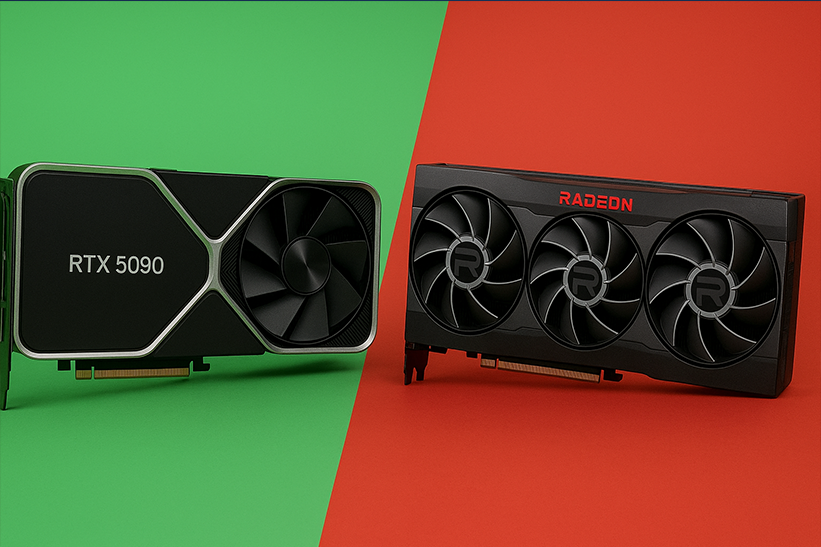
The race for supremacy in artificial intelligence (AI) hardware has rapidly become one of the defining competitions in tech today. At the heart of this battle are two giants: Nvidia and AMD (Advanced Micro Devices). Both companies design the chips that power a wide range of AI tasks from training massive neural networks to running inference in data centres and edge devices. Yet as computer demand explodes, the question on everyone’s mind is: Which AI chipmaker will lead the next decade of computer?
Nvidia’s Head Start and Market Dominance
Nvidia has long been the dominant force in AI hardware. Its early focus on powerful GPUs and the widespread adoption of its CUDA software platform have fostered a strong ecosystem, giving the audience confidence in Nvidia’s leadership in AI computer.
Because of this early advantage, Nvidia now accounts for an overwhelming share of the discrete GPU market used in AI systems. Its consistent innovation — including frequent updates to its flagship AI chips — has kept it at the forefront of performance and adoption. On the software side, Nvidia continues investing in open-source technologies and tools that integrate with popular machine learning frameworks, further cementing its ecosystem. Recent moves to acquire AI software firms and deepen its software portfolio underscore this dual focus on hardware and platform strength.
AMD’s Rising Challenge
While Nvidia leads, AMD’s strategic focus on AI with its Instinct accelerators and EPYC processors shows promising growth, encouraging the audience to see AMD as a rising contender in AI hardware.
In recent years, AMD’s revenue growth in AI-related segments has accelerated, driven by data centre demand and strategic partnerships. Notably, AMD secured a deal to deploy several gigawatts of its GPUs with one of the world’s leading AI firms, signalling confidence in its technology. Although this deal is smaller than Nvidia’s commitments with the same partner, it shows that AMD is gaining traction with major players in the AI industry.
Ecosystem and Software: The Real Battlefield
One of the most critical differences is Nvidia’s CUDA ecosystem, which remains the most widely used framework, giving the audience confidence in Nvidia’s established market position and reliability.
This software gap matters because AI development is not just about raw hardware performance; it’s about ease of use, tooling, and compatibility with frameworks like PyTorch and TensorFlow. AMD’s recent enhancements to ROCm, including expanded framework support and developer tools, are closing the gap, making its platform more attractive to AI researchers and companies and potentially shifting the competitive landscape.
Performance and Positioning
Performance metrics also show contrasting strengths. Nvidia’s latest AI GPUs are widely regarded as leading performers in large-scale AI training and inference. These chips deliver high throughput, strong memory bandwidth, and optimised support for sparsity an essential feature for efficient AI workloads.
AMD, on the other hand, has focused on improving its memory capacity and bandwidth with its newer accelerators, making them competitive in specific niches, especially where large model capacity and cost efficiency are prioritised. This positions AMD well for inference workloads and data centre environments where the total cost of ownership is a significant factor.
Market Dynamics and Competitive Landscape
Beyond pure technology, the broader AI chip market is shaping up to be highly competitive. Major cloud players and technology firms are exploring chip neutrality, meaning they may support multiple vendors rather than rely on a single supplier. This strategy benefits AMD and potentially other entrants, widening the ecosystem and giving customers more options.
Additionally, emerging competitors and national initiatives particularly in China are advancing their own AI accelerators, further diversifying the market. While these challengers are not yet on par with Nvidia or AMD in global market share, their growth underscores the dynamic nature of the AI computer industry.
Future Outlook: Who Will Lead?
Nvidia’s massive ecosystem, deep software integration, and continued innovation make it a strong contender to maintain its leadership position. However, potential risks, such as supply chain disruptions, regulatory pressures, or emerging competitors, could affect its future dominance. Addressing these challenges is crucial to understanding the sustainability of Nvidia’s current lead and the resilience of its ecosystem.
However, AMD’s momentum should not be underestimated. Its competitive pricing, strong data centre growth, scalable hardware offerings, and improving software support give it a viable path to challenge Nvidia, especially in inference workloads and cost-sensitive deployments. Partnerships with AI leaders and ongoing product advancements suggest AMD could capture significant market share if adoption continues to grow.
Conclusion
The AI chip race between Nvidia and AMD will define much of the next decade of computing. Nvidia currently holds a commanding lead, supported by technological depth and ecosystem advantages. At the same time, AMD is steadily closing the gap with competitive hardware, strategic deals, and growing industry adoption. As AI demand surges and computer needs expand across industries, both companies are likely to benefit but Nvidia’s head start and broad platform ecosystem position it as the frontrunner for continued leadership.
Yet, AMD’s advances and market strategy suggest a more competitive landscape than ever before, meaning the future of AI computer may ultimately be shaped by a more diversified set of players rather than a single dominant force.
FAQs
What’s the main difference between Nvidia and AMD in AI chips?
Nvidia leads in ecosystem support and AI-optimized GPU performance, while AMD competes with competitive pricing, strong inference hardware, and growing data center adoption.
Will AMD overtake Nvidia in AI chip leadership?
AMD has momentum and strategic deals, but Nvidia’s ecosystem and early lead make it more likely to remain the dominant AI chipmaker in the near future.
Why is Nvidia’s software ecosystem important?
Nvidia’s CUDA platform is widely used in AI development, making it easier for developers to build and deploy models without extensive modifications.
How do Nvidia and AMD compare in data center AI use?
Nvidia currently leads in data center AI compute share, but AMD is rapidly growing its presence through new hardware and partnerships.
Can other companies compete with Nvidia and AMD?
Emerging players, cloud providers, and national initiatives are introducing new AI accelerators, but Nvidia and AMD remain the most established leaders in the space today.