

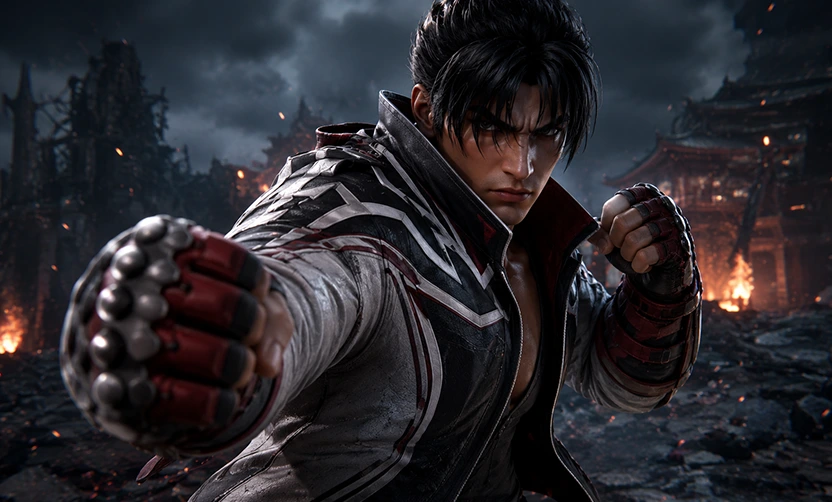
If you’ve ever picked up a Tekken game, you already know who Jin Kazama is. The brooding, white-haired warrior on the cover of Tekken 8 is arguably the most recognizable face in 3D fighting game history. But whether you’re a first-time player trying to figure out who to main, or a returning fan catching up on everything this character brings to the table in 2026.
Who Is Jin Kazama? The Icon Explained
Jin Kazama (風間 仁, Kazama Jin) is a fictional character and the central protagonist of Bandai Namco’s legendary Tekken franchise. First introduced in Tekken 3 in 1997, he took over the mantle of main character from his father Kazuya Mishima and has remained the face of the series ever since through every entry up to and including Tekken 8.
He is the son of Kazuya Mishima and Jun Kazama, making him part of the most dysfunctional bloodline in video game history. From his father’s side, Jin inherited the cursed Devil Gene a genetic abnormality that transforms its carriers into demonic, superhuman beings with abilities like flight, enhanced healing, and a devastating laser beam fired from a third eye. From his mother’s side, he carries the gentle, spiritual traditions of the Kazama clan.
This internal war between light and darkness defines everything about Jin Kazama his story, his personality, and even his fighting style. If you want to understand the full competitive context Jin operates in today, check out the Tekken 8 ranked picks guide on PlayXArena for a breakdown of how he stacks up against the current roster.
Jin Kazama’s Full Story From Tekken 3 to Tekken 8
Tekken 3: The Beginning of a Legend
Jin’s story begins with tragedy. At age 15, he discovered he was the son of Kazuya Mishima while simultaneously losing his mother, Jun Kazama, to the monstrous creature known as Ogre. Seeking revenge, he trained under his grandfather Heihachi Mishima and mastered both the Kazama-style of traditional martial arts and Mishima-style fighting karate.
During Tekken 3, he succeeded in defeating True Ogre but in a devastating betrayal, Heihachi ordered his grandson shot and left for dead. Jin survived only because the Devil Gene within him awakened, transforming him briefly into the demon form later known as Devil Jin. This moment cemented his rage against the entire Mishima bloodline.
Tekken 4 & 5: Rejecting the Mishima Heritage
After the events of Tekken 3, Jin turned his back on everything Mishima. He unlearned Mishima-style karate entirely and replaced it with traditional karate, studying under a new dojo master to symbolically cut himself off from the cursed blood running through his veins.
Tekken 4 introduced the concept of the Devil Gene explicitly for the first time. Jin entered the fourth King of Iron Fist Tournament with one goal: destroy the evil Mishima bloodline his grandfather Heihachi, and now his father Kazuya. By Tekken 5, after the battle in Honmaru, Jin was completely overwhelmed by the Devil Gene and set off on a desperate journey before its power could consume him entirely.
Tekken 6: The Villain Arc Nobody Expected
This is where Jin Kazama’s story gets complicated and controversial. In Tekken 6, Jin seized control of the Mishima Zaibatsu corporation and plunged the entire world into armed conflict. Nations went to war. Civilians died. The character many fans had come to love as a reluctant hero had seemingly become a warmongering dictator.
The in-story justification was tied to Azazel, claimed to be the progenitor of the Devil Gene. Jin believed that by igniting global chaos and suffering, he could resurrect Azazel, defeat the creature permanently, and wipe the Devil Gene from existence even at the cost of his own life. He did ultimately defeat Azazel, but fell into a coma, leaving the world he destroyed to deal with the consequences.
Many fans still struggle with this arc. As one analysis from EventHubs put it (April 2025), his actions were “reckless” and resulted in “massive loss of life” and in Tekken 8, the other characters largely gloss over Jin’s war crimes rather than holding him accountable, which continues to be a point of fan debate.
Tekken 7: Redemption on the Horizon
After waking up in the care of his uncles Lars Alexandersson and Lee Chaolan, Jin accepted his role as the person who must stop Kazuya Mishima. His struggle with the Devil Gene continued, and his own control over the transformation remained fragile and unpredictable. But the seeds of redemption were planted here.
Tekken 8: The Final Battle and a New Beginning
Tekken 8, released in January 2024 and continuing to receive updates through 2026, centers entirely on Jin’s effort to atone for the past and end the conflict with his father once and for all. According to Bandai Namco’s official story summary, Jin despises the cursed blood running through his veins and joins forces with Lars Alexandersson to execute “Operation Lightning” a plan to eliminate Kazuya, the other active carrier of the Devil Gene.
The story of Tekken 8 sees Jin grappling with a startling development: during his battle against Azazel in Tekken 6, he learned to control his inner devil power. When the game begins, he discovers he can no longer reliably activate the Devil Gene at will a massive vulnerability that forces him to journey to the Kazama Sanctum at Yakushima to reconnect with his origins.
In an emotionally charged story mode conclusion, Jin finally accepts both his devil side and his past. Visions of his mother Jun help him unlock his Angel Jin form, and he battles Kazuya all the way into outer space. Their final clash erases Azazel’s existence entirely and strips both father and son of the Devil Gene leaving them as regular humans who continue their fight until Jin ultimately defeats Kazuya.
It’s a satisfying if complex endpoint to a decades-long saga. Though as the story notes, a new Devil Gene carrier has appeared in the form of Reina, ensuring the franchise’s central mystery will continue.
The Devil Gene: Jin’s Core Conflict Explained
The Devil Gene is at the heart of everything Jin Kazama represents. It’s a genetic abnormality that originated on the maternal side of the Mishima family through Kazumi Mishima (Heihachi’s wife, Kazuya’s mother), and was passed down to Kazuya, and then to Jin.
Those carrying the Devil Gene can transform into powerful demonic forms during moments of extreme stress or mortal danger. For Kazuya, this transformation aligns perfectly with his personality he embraces the power because his own desires for revenge and domination mirror the Devil’s goals.
Jin’s relationship with the Devil Gene is the opposite. His first instinct was to reject and resist it, which paradoxically made it harder for him to control. His devil form Devil Jin operates almost as a separate protective persona. Unlike Kazuya’s devil, which acts with pure malice, Devil Jin tends to emerge specifically to protect Jin when the human side of him is overwhelmed, and has never been shown to attack innocent people out of cruelty.
This nuance is what makes Jin Kazama such a compelling character study. Even when making catastrophically bad decisions (like in Tekken 6), he’s acting on a warped but real belief that he’s saving humanity from something worse. As Tekken wiki analysis notes, Jin “shows clear remorse for his previous actions” in Tekken 8, driven by a desire to atone rather than to rule.
Jin Kazama’s Fighting Style Everything You Need to Know
A Style Built on Versatility
Jin Kazama’s fighting style has evolved significantly throughout the series. In Tekken 3, he combined Kazama-style Traditional Martial Arts with Mishima-style Fighting Karate. After Tekken 4, he abandoned the Mishima heritage entirely and switched to Traditional Karate a cleaner, more disciplined style that reflects his desire to distance himself from his cursed bloodline.
In Tekken 8, his style returns to a hybrid of the two for Story Mode’s final battle, but in standard gameplay he uses traditional karate enhanced by the game’s new mechanics.
Why Jin Is Considered a “King of Neutral”
Among competitive Tekken 8 players, Jin Kazama is widely known as one of the best neutral game characters in the entire roster. His move list gives him tools for almost every situation a powerful mid-range poke game, reliable launchers, smart spacing options, and enough defensive tools to weather pressure without panicking.
In Tekken 8 specifically, the development team streamlined his moveset in a meaningful way. Previous iterations had Jin players needing to memorize which specific move countered which specific situation. In Tekken 8, many of his options serve double duty a single move that works both as a punisher and a neutral tool, for example. This makes him genuinely beginner-friendly without sacrificing depth for advanced players.
Key Moves and Mechanics in Tekken 8
Pokes and Neutral Tools: Jin’s strength in the neutral game comes from his ability to control the pace of a match. His mid-range attacks are reliable, hard to step around, and lead into solid damage when they connect. Opponents who don’t respect his poke game get punished quickly.
Electric Wind God Fist (EWGF): Like all Mishima-lineage characters, Jin has access to the Electric Wind God Fist a highly powerful launcher that requires a precise input (f ★ d/f executed quickly) to trigger its electric properties. However, unlike his father Kazuya who depends heavily on the EWGF, Jin is specifically designed around not needing it. You can succeed with Jin even if you never land a single Electric in a match. That said, mastering the input unlocks additional combo routes and significantly higher damage output, giving Jin one of the highest skill ceilings in the game.
Heat System Synergy: In Tekken 8’s Heat system, Jin gains access to enhanced moves and extended combo opportunities that complement his already dominant neutral game. His Heat options are well-integrated with his standard toolkit, making him a nuisance to opponents who throw out unsafe attacks trying to force an opening.
Rage Art: Jin’s Rage Art is a powerful comeback mechanic available when his health is critically low, consistent with the high-drama battles the character is known for in the story.
Devil Jin vs. Jin What’s the Difference?
Devil Jin is actually a separate selectable character in Tekken 8, not just a form Jin enters mid-match. While regular Jin uses Traditional Karate, Devil Jin plays with Mishima-style Fighting Karate the style Jin abandoned after Tekken 3. Devil Jin is faster, more explosive, and features different combo routes centered around Mishima Electric inputs and demonic abilities. Both characters share DNA but feel meaningfully different to play.
Jin Kazama’s Competitive Viability in 2026
Where Jin Stands in the Current Meta
As of Season 3 of Tekken 8 (2026), Jin Kazama continues to be a strong and reliable pick at all levels of competitive play. He sits comfortably in the upper tier not the absolute top, but firmly among the fighters that tournament players respect and prepare for.
His ranking reflects his consistent design philosophy: Jin is not a character with a single overwhelming gimmick you spam to victory. His strength comes from fundamentally sound tools across every dimension of play neutral, punishing, combo damage, and defensive options. This makes him one of the safest characters to invest time into, because good Jin fundamentals transfer naturally into overall Tekken knowledge.
The Season 3 patch introduced changes to the Heat Smash system (Heat Smashes no longer trigger wall splats), which affected some characters dramatically. Jin was relatively unscathed compared to characters whose entire gameplan relied on wall-splat conversions.
Is Jin Good for Beginners?
Yes and this is somewhat unusual for a character with his level of depth. The Tekken 8 development team specifically streamlined Jin’s moveset to be more accessible without gutting his options. New players can pick Jin and immediately understand what his moves are for and when to use them. He “looks really awesome” and has a clear game plan that builds Tekken fundamentals organically as you learn him.
For players climbing the ranked ladder, our friends over at PlayXArena’s Tekken 8 ranked picks breakdown specifically highlight Jin as one of the most recommended characters for climbing without tournament-level execution requirements.
Is Jin Good for Advanced Players?
Also yes. The EWGF ceiling, his neutral spacing game, and his Heat synergy give experienced players enormous room to squeeze out efficiency that casual players never access. Jin rewards practice without ever becoming easy to “solve” for opponents.
Jin Kazama’s Relationships and the Mishima Family Tree
Understanding Jin means understanding the web of family trauma around him:
Kazuya Mishima (Father): Jin’s primary antagonist across most of the series. Kazuya is a man defined by hatred and a desire for power, whose Devil Gene has merged perfectly with his own dark ambitions. Their conflict drives the entire Tekken 8 story.
Jun Kazama (Mother): The gentle spiritual counterweight to everything Mishima. Jun’s disappearance at the hands of Ogre is Jin’s founding trauma. Her reappearance in Tekken 8’s story and the role her presence plays in helping Jin access his Angel form is one of the game’s most emotionally significant moments.
Heihachi Mishima (Grandfather): Killed in Tekken 7’s story, Heihachi trained Jin and then immediately betrayed him setting the cycle of trauma and violence in motion for another generation.
Lars Alexandersson (Uncle): One of Heihachi’s illegitimate sons and Jin’s most consistent ally in Tekken 7 and 8. Lars is the moral anchor of Operation Lightning.
Asuka Kazama (Relative): A distant relative on the Kazama side, Asuka is a recurring character in the series and one of the few connections Jin has to the non-Mishima side of his family.
Reina (Aunt): The newest complication in the Devil Gene story. Reina carries the Devil Gene and is revealed to be a daughter of Heihachi, meaning the curse isn’t gone even after the events of Tekken 8’s main story.
Devil Jin: Not a separate person, but Jin’s demon alter ego the unleashed version of the Devil Gene that takes over when Jin loses control. Devil Jin in the games plays with a more Mishima-centric style and is often considered the “dark mirror” of who Jin could become.
Jin Kazama’s Cultural Impact and Reception
Jin Kazama is consistently ranked among the most beloved and significant characters in fighting game history. Since his introduction in Tekken 3, he has been described as one of the best Tekken characters due to his fighting style and his impact on the game’s storyline.
From a design perspective, Jin was created by Namco artist Yoshinari Mizushima using the concept of a “misfortune character” someone whose dark arc would be a defining through-line across multiple games. The concept worked. Jin’s dark characterization resonated so deeply that he remained the central figure through eight mainline games, anime films, crossovers like Street Fighter X Tekken, and various spin-off media.
Academically, his character has even been analyzed through a Jungian lens. A 2025 study published in the ELite Journal: International Journal of Education, Language and Literature examined Jin’s internal conflict with the Devil Gene as a confrontation with Jung’s “Shadow” archetype, while his relationship with his mother represents integration of the “Anima.” The paper argues that Tekken 8 traces Jin’s journey toward psychological individuation growing into a complete, integrated self.
The character’s popularity also contributed to Tekken 8’s strong commercial performance. The game sold over 2 million copies in its first month after the January 2024 launch, and crossed 3 million sales by February 2025, making it one of the most successful entries in franchise history.
How to Play Jin Kazama Tips for Every Skill Level
For New Players
Start by learning his core punishing tools. Jin has reliable launchers that aren’t hidden behind complex inputs, which means even day-one players can convert hits into meaningful damage. Practice his basic combos in training mode before worrying about the Electric Wind God Fist. Focus on spacing staying at the range where his mid pokes thrive is the key to early success.
For Intermediate Players
Work on his neutral game decision-making. Jin’s power lies in making the right call at the right moment when to apply pressure, when to hold back and bait a whiff, and when to commit to a launcher. At this stage, start introducing the EWGF input into your training. Even landing it occasionally opens up new combo routes.
For Advanced Players
Master the Heat system integration. Experienced Jin players use Heat activation at precisely the right moments to extend pressure and convert situations that would be dead ends at lower levels. Study frame data for his key moves to understand when you’re plus on block (and therefore can apply pressure) versus when you should be more conservative.
Performance Optimization
One underrated aspect of playing Jin at a high level is your setup itself. Tekken 8 is built on Unreal Engine 5 and locked to 60 FPS, meaning any frame drops below that number directly impact your ability to execute tight inputs like the EWGF. If you’re running into performance issues, the Tekken 8 Low FPS Fix guide at PlayXArena covers everything you need to optimize your PC setup for competitive play.
Jin Kazama in Other Media
Beyond the main Tekken games, Jin Kazama has appeared in:
- Tekken: The Motion Picture (1998) — early OVA anime
- Tekken: Blood Vengeance (2011) — CGI feature film set between Tekken 5 and Tekken 6
- Tekken: Bloodline (Netflix, 2022) — animated series loosely based on Tekken 3, voiced by Kaiji Tang in English
- Street Fighter X Tekken — crossover where he appeared alongside Capcom’s roster
- Tekken (2010 live-action film) — portrayed by Jon Foo
- PUBG Mobile — special crossover content
The Netflix series Tekken: Bloodline introduced Jin to an entirely new audience and generated renewed interest in his backstory among viewers who hadn’t played the games.
Frequently Asked Questions About Jin Kazama
Is Jin Kazama the main character of Tekken?
Yes. While Kazuya Mishima was the protagonist of the original Tekken, Jin took over as the central figure from Tekken 3 onward and has remained the primary protagonist through Tekken 8.
What fighting style does Jin Kazama use?
In most mainline games from Tekken 4 onward, Jin uses Traditional Karate. In Tekken 3 and in Tekken 8’s final story battle, he uses a hybrid of Mishima-style Karate and Kazama Traditional Martial Arts.
Is Jin good in Tekken 8?
Yes Jin is considered an upper-tier character with well-rounded tools that work at both beginner and high-level competitive play. He has particularly strong neutral game options and solid fundamentals that reward practice.
What is Devil Jin?
Devil Jin is the demonic transformation of Jin Kazama caused by the Devil Gene. In the games, he functions as a separate playable character who uses Mishima-style fighting karate with demonic abilities including flight and a laser beam from a third eye.
Does Jin have the Devil Gene in Tekken 8?
At the start of Tekken 8, Jin struggles to activate his Devil Gene reliably. By the end of the story, the conflict with Kazuya and Jun’s presence essentially heals both father and son of the Devil Gene, returning them to regular humans.
What happened to Jin Kazama after Tekken 8?
The canonical ending of Tekken 8’s story has Jin defeating Kazuya and both being freed from the Devil Gene. The franchise future is open with Reina now revealed as a Devil Gene carrier, the next chapter remains unwritten.
For more esports events, and gaming coverage, explore the gaming section at PlayXArena and the esports coverage hub for the latest from the fighting game community.
