

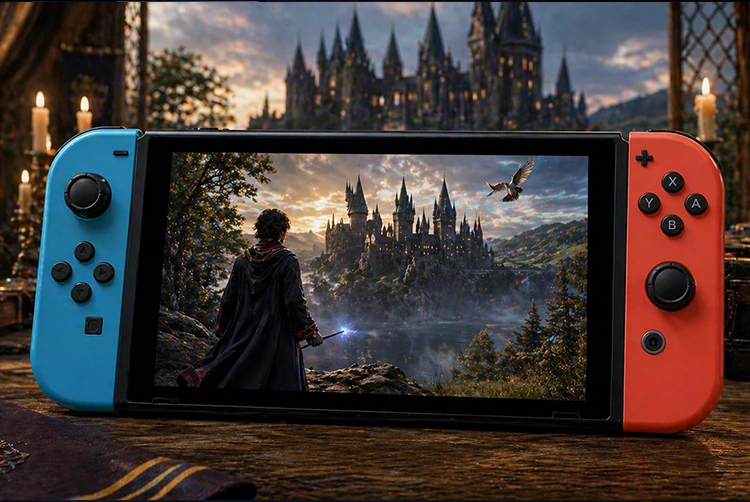
Hogwarts Legacy Nintendo Switch is a game with two very different stories to tell. The original Switch version released November 14, 2023 was a remarkable technical achievement and a significant compromise simultaneously: a massive open-world RPG squeezed onto aging handheld hardware, delivering the full game at a price paid in resolution, frame rate, and visual fidelity. The Nintendo Switch 2 version released June 5, 2025 — is a completely different beast: a brand-new port with DLSS support, up to 1440p docked resolution, 60fps performance mode, ray tracing, and HDR that closes the gap with PS5 dramatically.
If you enjoy massive open-world RPGs and want to benchmark Hogwarts Legacy against the best the genre offers, our top 25 best RPG games covers the definitive list. And for performance comparisons across platforms and how gaming hardware shapes your experience, our Sony PS5 Pro vs PS5 breakdown is worth reading alongside this guide.
Hogwarts Legacy Nintendo Switch Performance in 2026
The Specs at a Glance
| Spec | Original Switch |
|---|---|
| Target Frame Rate | 30 FPS |
| Docked Resolution | 1080p |
| Handheld Resolution | 720p |
| Upscaling | None |
| Ray Tracing | No |
| HDR | No |
| Storage Required | ~32 GB |
| Loading Times (area transitions) | 20–30 seconds |
| Price (2026) | ~$49.99 |
Frame Rate Reality
The original Switch version targets 30 FPS — and in open outdoor areas with lower NPC density, it largely holds that target. The frame rate becomes noticeably inconsistent in three specific scenarios:
In dense areas like Hogsmeade or inside Hogwarts castle, frame rates can dip into the 25–28 FPS range. During intense combat with multiple enemies and spell effects firing, you might see drops to the low 20s. In more open outdoor areas with fewer NPCs and simpler geometry, the game holds closer to that 30 FPS target.
This is actually improved compared to launch. Patches in 2024 and 2025 improved consistency, but 30 FPS is still noticeably choppier than what you’d experience on PS5 or PC at 60+ FPS.
Visual Quality
Docked mode looks sharper than handheld — that 1080p-to-720p gap is visible, especially on text and distant objects. On a large TV, docked performance feels more comfortable, though the frame rate ceiling of 30 FPS remains noticeable in fast-paced sequences.
The Switch version uses reduced texture quality, simplified shadow rendering, lower-resolution effects, and less detailed NPC models compared to PS4, PS5, Xbox, and PC versions. Hogwarts castle’s interior — one of the most visually stunning environments in the game on high-end hardware loses significant atmospheric lighting fidelity on Switch. The difference between the Switch version and PS5 is substantial and immediately visible.
Stability in 2026
The most common early issues black textures, freezing, and frequent crashes — were addressed in patches throughout 2024. By 2025, stability has improved significantly. The current version (as of March 2026) is substantially more stable than launch.
These aren’t widespread game-breaking issues affecting most players. They’re edge cases that occur in less than 1% of play sessions for most people. If you play 50 hours, you’ll likely encounter zero bugs. If you push 100 hours, you might hit one minor glitch.
Storage Requirements
The game requires about 32 GB of storage on the Switch, which is substantial. If you have a 64 GB Switch with limited free space, this game will dominate your storage. A microSD card is effectively mandatory for most players. Budget at least a 128 GB card if you’re installing Hogwarts Legacy alongside other games.
Is the Original Switch Version Worth It in 2026?
Hogwarts Legacy Nintendo Switch runs at 30 FPS (1080p docked, 720p handheld) with reduced textures and effects compared to PS5 and PC, but delivers the full game experience with all content intact. The Switch version excels in portability, allowing you to play a full AAA RPG on the go, making it ideal for players without access to a gaming PC or home console.
Buy the Switch version if portability is your priority; skip it if you own a PS5, Xbox, or gaming PC, or if you’re sensitive to frame rate performance below 60 FPS.
The original Switch version is currently rated 7.5/10 specifically as a Switch version — the game itself is excellent; the version is a compromise you choose knowingly.
Hogwarts Legacy Nintendo Switch 2 The Definitive Portable Version
Everything Changed
Hogwarts Legacy Nintendo Switch was pretty naff, let’s be honest. A remarkable achievement, but one that was inevitably heavily compromised just to get it running at the low level that it managed. By contrast, Hogwarts Legacy Nintendo Switch 2 is a huge accomplishment that captures so much more of the tone and feel of the game on PS5, Xbox Series X or PC that it feels so much more worth playing.
This is not an upscaled port of the original Switch version. This is a brand-new port of the game to Nintendo Switch, retaining none of the heavy compromises that were needed to work on Switch, and making its own adjustments to match the new hardware platform’s strengths and weaknesses. The difference is night and day.
Switch 2 Specs at a Glance
| Spec | Nintendo Switch 2 |
|---|---|
| Docked Resolution | Up to 1440p (DLSS) |
| Handheld Resolution | 1080p (DLSS) |
| Upscaling | Nvidia DLSS |
| Performance Mode | 60 FPS |
| Fidelity Mode | 30 FPS |
| Ray Tracing | Yes (Fidelity mode) |
| HDR | Yes (handheld) |
| Mouse Controls (Joy-Con) | Yes |
| Loading vs Switch 1 | Significantly faster |
| Upgrade Price (from Switch 1) | $9.99 |
| Full Purchase Price | $59.99 |
Resolution and DLSS
The developers have already confirmed that Hogwarts Legacy will run on the Nintendo Switch 2 in 1,440p resolution on the TV and in 1,080p in handheld mode, both with Nvidia DLSS, edge smoothing and HDR support enabled.
DLSS — Deep Learning Super Sampling — is the same AI-powered upscaling technology found in NVIDIA GeForce RTX graphics cards. On Switch 2, it renders the game at a lower native resolution then reconstructs the image using machine learning, producing a significantly sharper result than the Switch 1’s unassisted rendering. The native rendering resolution on Switch 2 is approximately 720p docked, upscaled to 1440p via DLSS — and community analysis from NeoGAF and Digital Foundry confirms the result is genuinely impressive for that starting resolution.
Graphics Performance Modes
They have graphics performance options, ranging from 30fps fidelity and ray tracing modes, through a standard 60fps performance mode and even a higher frame rate mode.
This is a substantial upgrade over the original Switch’s locked 30fps target with no quality options whatsoever. Switch 2 players can choose:
Fidelity Mode — 30 FPS with ray tracing enabled. Produces the closest visual match to the PS5 version’s graphical quality. Best for slower-paced exploration and enjoying the castle environments at their best.
Performance Mode — 60 FPS, ray tracing disabled. The recommended mode for combat-heavy play. Responsive, smooth, and dramatically better than the original Switch’s choppy 30fps during spell battles.
High Frame Rate Mode — Targets above 60fps in less demanding scenes. An option for players with compatible displays who want the smoothest possible experience.
Visual Quality Comparison vs Switch 1
The often very flat lighting and shading of the interior of Hogwarts on Nintendo Switch is replaced by the rich light and dark of more realistic internal lighting and illumination on Switch 2. This is one of the key areas where the game gets much closer to the game on PS5.
The improvements are specific and meaningful in the areas that matter most to the Hogwarts experience:
- Interior lighting — dramatically richer contrast between illuminated and shadowed areas throughout the castle
- Shadow quality — real-time shadows replace the baked shadow approximations of the Switch version
- Texture resolution — noticeably sharper on surfaces, floors, and environmental details
- Spell effects — more detailed particle effects during combat
- Character models — improved detail on faces and hair versus the notably degraded versions in the original port
The Switch 2 version is not PS5 quality — that comparison is addressed honestly below — but it is meaningfully, visibly better than the original Switch port in every dimension.
How Switch 2 Compares to PS5
The main comparison, to my mind, would be from Switch 2 to PS5 performance mode. Not the max fidelity or performance, but the safe middle-ground. With this, you definitely notice some of the compromises still being made for Switch 2.
The most visible remaining compromises versus PS5: hair rendering retains some jagged edges that DLSS can’t fully resolve, reflective surfaces in Hogwarts show a more speckled quality at distance, and the base rendering resolution means fine details require the DLSS reconstruction to reach their displayed quality.
According to the Digital Foundry face-off analysis (July 2025), the Switch 2 version in docked mode performs comparably to a PS4 in overall fidelity, with the DLSS upscaling bridging a significant visual gap. The Switch 2’s CPU advantage over PS4 (approximately double the CPU performance at IPC level) means gameplay performance is more stable even where raw GPU output is comparable.
Loading Times
“The performance of the Nintendo Switch 2 has not only improved the frame rate from the Nintendo Switch version, but also reduced the loading time. You can comfortably fly around the Hogwarts grounds and beyond.”
The original Switch version’s 20–30 second loading times during area transitions are one of its most immersion-breaking compromises. Switch 2 reduces these substantially, and the open-world seamless traversal — flying on broom across the Hogwarts grounds without load screens — is dramatically smoother.
The $10 Upgrade Path
Warner Bros. is offering upgrade pricing. If you own the game on Switch 1, you can access a DLC from the game’s main menu to enable a discount price for the full Switch 2 game to bring it down to $10 or £8.50. This could have been made more obvious with a Switch 2 Edition style release, but has the major benefit that you won’t need the Switch 1 cartridge to play anymore, if you’re coming from a physical copy. For one of the biggest generational leaps you’ll ever likely see, that’s a bargain.
Important process note: Customers who own Hogwarts Legacy on a game module can upgrade to the new version for $10, but this option must first be activated in the game before purchasing the upgrade from the eShop and downloading the new version. You must launch the original Switch version first, trigger the upgrade option from the main menu, then purchase and download from the eShop. You don’t need the Switch 1 cartridge inserted after completing this process.
Joy-Con mouse mode is also supported, using the new Joy-Con’s mouse functionality for menu navigation and certain gameplay interactions.
Full Hogwarts Legacy Gameplay Guide — What You’re Actually Playing
Regardless of which version you’re on, here’s everything you need to know about the game itself.
The Story
Hogwarts Legacy is set in the 1800s — centuries before Harry Potter — in an original story entirely separate from the film and book narratives. You play as a fifth-year student who arrives at Hogwarts unusually late and immediately discovers the ability to perceive and control Ancient Magic, a mysterious and powerful form of magic lost to history.
The central threat is a goblin rebellion led by Ranrok, who has allied with dark wizard Rookwood in a scheme to access a repository of Ancient Magic hidden beneath Hogwarts. As the only student capable of interacting with Ancient Magic, you are the key to either unlocking or protecting that power.
The story avoids many expected Harry Potter beats precisely because it’s set so far in the past. There’s no Voldemort, no Dumbledore (except as a portrait of an ancestor), and no established franchise characters to lean on. This gives Avalanche Software room to build an original narrative that works on its own terms.
Character Creation
Hogwarts Legacy features one of gaming’s most robust character creators, including:
- House selection (Gryffindor, Hufflepuff, Ravenclaw, Slytherin) — each with unique common rooms and some house-specific quest content
- Full appearance customization (face, hair, body type, skin tone — no gender lock on any options)
- Voice selection independent of appearance
- Wand customization (wood, core, length, flexibility, style)
Your house choice affects which students you interact with most and which house-specific questline you access, but the core story is identical across all four houses.
Combat — Spells, Ancient Magic, and Talent Trees
Combat in Hogwarts Legacy is third-person action RPG with a spell-based loadout system. You assign spells to face buttons and shoulder button combinations, creating a palette of six active spells plus a basic attack.
Core spell categories:
Control spells — Accio (pull), Depulso (push), Wingardium Leviosa (levitate), Glacius (freeze). These control enemy positioning and create combo opportunities.
Damage spells — Expelliarmus, Bombarda, Confringo (fire), Diffindo (cutting). Direct damage with varying AOE and elemental properties.
Curses — Avada Kedavra, Crucio, Imperio (the Unforgivable Curses). Powerful but morally significant; acquiring them requires specific quest choices.
Ancient Magic — A special meter that builds during combat, released as devastating area attacks or targeted spell amplifiers.
The shield system — Most enemies use colored shields (yellow, purple, red) that can only be broken by specific spell types. Knowing which spell breaks which shield is the core of combat strategy.
The Talent tree (accessed via the Field Guide menu) lets you invest points earned from leveling into upgrades across five categories: Spells, Dark Arts, Core, Stealth, and Room of Requirement.
Exploration — The Open World
The Hogwarts grounds and surrounding regions (Hogsmeade, Feldcroft, Clagmar Coast, and others) form an interconnected open world. Key exploration activities:
Collection chests — Standard loot chests containing gear and Galleons. Found throughout every area.
Merlin Trials — Environmental puzzles scattered across the map. Completing them expands your gear inventory (essential — you need more gear slots than you start with).
Moth Mirrors, Cube Puzzles, and Brazier Challenges — Secondary puzzle types that appear throughout the world and reward Revelio Pages, feeding into your Field Guide completion.
Astronomy Tables — Nightly alignment minigames tied to constellation lore.
Ancient Magic Hotspots — Specific environmental interactions that build Ancient Magic mastery and eventually unlock Hogwarts Secrets.
Vivarium creatures — Magical beasts found in the wild can be caught with the Nab-Sack and housed in your Room of Requirement Vivarium. Feeding and brushing them provides Beast Parts used for gear upgrades.
Fast travel via Floo Flames is available at every discovered location. Flying by broom is the fastest method for medium-distance travel. Hippogriff and Thestral mounts become available later in the game.
The Room of Requirement
Your personal Room of Requirement serves as the game’s crafting hub:
- Gear crafting table — Upgrade gear traits using Beast Parts
- Potting tables — Grow magical plants (Mandrake, Chinese Chomping Cabbage, Venomous Tentacula) used in combat
- Potion stations — Brew Edurus Potion (temporary rock-skin), Wiggenweld Potion (healing), Focus Potion (reduced spell cooldowns), and others
- Vivarium — Up to four biomes where you house rescued magical creatures
Investing in the Room of Requirement’s production capacity early significantly eases the mid-game difficulty curve — having a reliable supply of combat plants and potions changes how fights play out.
Side Quests and Companion Questlines
Beyond the main story, four companion questlines provide some of the game’s best character writing:
Natsai Onai — A Gryffindor student investigating the dark legacy of a mysterious figure connected to Hogsmeade. Her questline deals with Hogwarts’ own troubling history.
Sebastian Sallow — The most significant companion questline and the one that unlocks the Unforgivable Curses. Sebastian’s desperation to save his cursed sister from dying drives him to seek forbidden knowledge. The moral choices in his quest have real consequences.
Poppy Sweeting — Hufflepuff student focused on protecting magical creatures from poachers. Her questline unlocks key magical beasts and the Hippogriff mount.
Amit Thakkar — A fellow fifth-year with a passion for astronomy whose questline is lighter in tone but rewards completion with map-related content.
Tips and Tricks for All Switch Versions
Performance Optimization (Switch 1)
Adjust visual settings if possible — Some regional builds offer limited graphics options. Check Settings → Accessibility → Display for any available adjustments.
Close the game between sessions — Unlike the Switch’s sleep mode which suspends the process, fully closing and relaunching the game clears cached memory that can contribute to performance degradation over long sessions.
Play in handheld mode for similar visual quality at its intended resolution — The 720p handheld resolution is what the Switch is actually rendering. The 1080p docked output involves scaling, which means the handheld image and the docked image are more similar in native detail than the resolution numbers suggest.
Combat Tips
Break shields first, then damage — Attacking a shielded enemy with the wrong spell type deals no damage and wastes your cooldown. Always carry at least one spell for each shield color (Wingardium Leviosa or Accio for purple, Expelliarmus or Diffindo for yellow).
Use Levioso + Accio for control — Levitating one enemy with Levioso then pulling another with Accio creates crossfire knockback. Getting good at this two-spell combo manages crowds effectively in the mid-game before you have Avada Kedavra.
Ancient Magic Throw is often better than Ancient Magic finisher — The Ancient Magic Throw (L1 or L trigger during Ancient Magic meter full) lets you throw environmental objects and nearby enemies as projectiles. Against groups, this often deals more total damage than a single finisher.
Dodge through attacks, not away — Rolling through an incoming spell (dodging into the attack arc) often avoids damage better than rolling away from it. The dodge window is generous and the animation is quick.
Progression Tips
Complete Merlin Trials early — The gear inventory starts frustratingly small. Merlin Trials are the only way to expand it. Prioritize the first dozen trials before your inventory fills with gear you want to keep but can’t.
Upgrade gear traits, not gear rarity — Gear with desired traits (Concentration for damage bonuses, Ambush for stealth multipliers) can be upgraded to apply those traits at higher-rarity levels. Don’t discard a piece with the perfect trait just because its rarity tier is lower — upgrade it.
Sell regularly to Hogsmeade vendors — Gold runs out if you’re not selling excess gear constantly. Visit Hogsmeade vendors after clearing any large dungeon or bandit camp.
Complete Jackdaw’s Rest early — This is the quest that unlocks the Alohomora spell (lockpicking). Without it, you can’t open locked doors anywhere in the game. It’s available well before it’s obvious it’s important.
Which Version Should You Buy? — 2026 Decision Guide
Buy the Nintendo Switch 2 version if:
- You own a Switch 2 and don’t have a PS5, Xbox Series X, or gaming PC
- You already own the original Switch version — the $10 upgrade is one of gaming’s most justified upgrade purchases given the visual and performance leap
- Portability at a high quality level is your primary use case
- You want 60fps gameplay in a Harry Potter RPG on a handheld device
Buy the original Nintendo Switch version if:
- You don’t own a Switch 2 and have no plans to upgrade
- Portability matters more than visual quality — the game is fully playable at 30fps
- You find the Switch 1 version at a significantly discounted price (often $30–35 on sale)
- You want the game on Nintendo hardware but can’t justify the Switch 2’s price
Skip the Switch and play on another platform if:
- You own or are considering a PS5, Xbox Series X, or gaming PC — those versions deliver 60fps at higher fidelity without compromise
- You’re particularly sensitive to frame rates below 60fps
- You want the best-looking version of this specific game
Platform Comparison at a Glance
| Platform | Resolution | Frame Rate | Ray Tracing | Notes |
|---|---|---|---|---|
| PC (High-End) | 4K native | 60–120+ FPS | Yes | Best version available |
| PS5 | 4K / 1440p | 60 FPS | Yes | Excellent console version |
| Xbox Series X | 4K | 60 FPS | Yes | On par with PS5 |
| Nintendo Switch 2 | 1440p (DLSS) | 30 or 60 FPS | Yes (Fidelity mode) | Best portable version |
| Xbox Series S | 1080p | 60 FPS (Performance) | Limited | Good value option |
| PS4 / Xbox One | 864p–900p | 30 FPS | No | Last-gen versions |
| Nintendo Switch | 1080p (docked) | 30 FPS | No | Compromised but playable |
Frequently Asked Questions
Is Hogwarts Legacy on Nintendo Switch worth buying?
Yes, with caveats. The original Switch version delivers the full game at 30fps with reduced visuals — it’s worth buying if portability is your priority and you don’t have access to a higher-end platform. The Switch 2 version is significantly better and worth the purchase or $10 upgrade if you have that hardware.
What frame rate does Hogwarts Legacy run at on Switch?
The original Nintendo Switch version targets 30 FPS, with dips to 25–28fps in dense areas like Hogsmeade and during heavy combat. The Nintendo Switch 2 version offers a 60fps Performance Mode alongside a 30fps Fidelity Mode with ray tracing.
How long is Hogwarts Legacy?
The main story takes approximately 25–35 hours. Completing all side quests, Merlin Trials, collection activities, and companion questlines extends the total to 60–80 hours for full completionists.
Does Hogwarts Legacy have multiplayer or co-op on Switch?
No. Hogwarts Legacy is entirely single-player with no multiplayer, co-op, or online features of any kind. This applies to all platforms.
Can I transfer my save from Switch to Switch 2?
The Switch 2 version of Hogwarts Legacy is a separate purchase (or $10 upgrade), not a graphical patch for the original version. Save data does not transfer between the two versions you start fresh on Switch 2.
Is the Nintendo Switch 2 version of Hogwarts Legacy better than PS5?
No PS5 delivers higher native resolution, more consistent performance, and better overall fidelity. The Switch 2 version closes the gap significantly compared to the original Switch port, reaching a comparable level to PS4 Pro in base fidelity with DLSS bridging the visual gap further. It is the best portable version by a substantial margin.
For more on the best open-world RPGs available across all platforms, our best RPG games guide is the place to start. And if you want to understand how the Switch 2’s hardware fits into the broader console performance landscape, our PS5 Pro vs standard PS5 breakdown provides useful context on how hardware generations translate to gaming experiences.
