

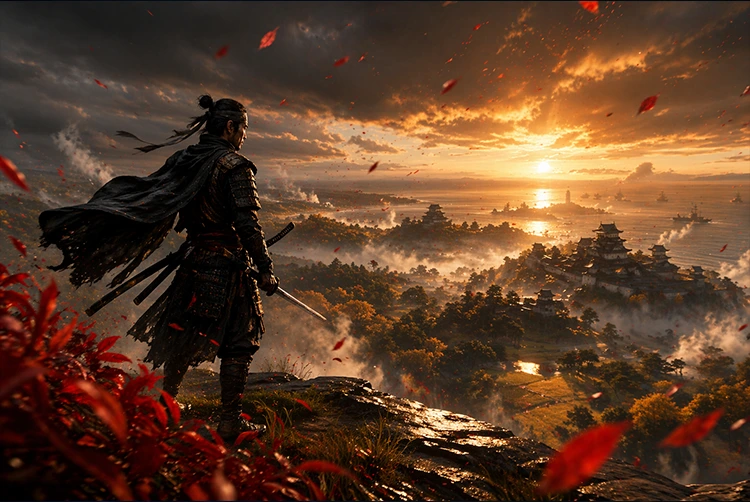
Ghost of Tsushima launched on July 17, 2020 the last significant PlayStation exclusive before the PS5 arrived and it landed with the specific quality of a game that knows exactly what it wants to be. It is not trying to reinvent open-world design. It is not making bold experimental choices. It is making a beautifully rendered, emotionally earnest samurai epic and executing it with a craftsmanship that most games in the genre spend their entire runtime striving toward and never quite reaching.
In 2026, Ghost of Tsushima: Director’s Cut available on PS5, PS4, and PC (Steam, May 2024) is rated “Mighty” on OpenCritic after being reviewed by 134 critics, with an overall average score of 87. It’s ranked in the top 2% of games and recommended by 97% of critics. On Steam, 93% of 36,767 user reviews are positive. These numbers hold up after five-plus years because the game’s core strengths combat, world design, atmosphere, the specific emotional register of Jin Sakai’s story haven’t dated the way a game relying on novelty alone would.
This review covers every version: the original PS4 game, the Director’s Cut on PS5, the Iki Island expansion, and the PC port from Nixxes Software. It covers what Ghost of Tsushima does brilliantly, what it does with acknowledged limitations, who should play it, and which version is worth your time and money in 2026.
If you’re comparing this to other major PS5 open-world titles before making a purchase decision, our 30 best PLaystation 5 games list covers the full competitive landscape. And for the hardware context of playing Ghost of Tsushima on the most capable PlayStation hardware currently available, our PS5 Pro vs PS5 comparison covers whether the upgrade is worth it for titles in this visual tier.
The Setup What Ghost of Tsushima Is
Ghost of Tsushima is a third-person open-world action adventure developed by Sucker Punch Productions (previously known for inFamous and Sly Cooper) and published by Sony Interactive Entertainment. Set in 1274 feudal Japan on the island of Tsushima, it follows Jin Sakai a samurai warrior and one of the last surviving members of his clan after the first wave of a Mongol invasion fleet led by the cunning general Khotun Khan decimates Tsushima’s defenders.
The game’s central conflict isn’t between Jin and Khan it’s within Jin himself. As a samurai, he was trained from childhood to value direct, honorable combat above all else. Against a superior army that fights dirty, poisons water supplies, and uses human shields, the samurai code becomes a liability. The path to liberating Tsushima requires Jin to become the Ghost a figure who uses stealth assassination, fear, poison, and deception. A figure the enemy fears in the dark. A figure that violates everything Jin was raised to be.
That internal conflict between honor and pragmatism, between the warrior he was trained to be and the warrior Tsushima needs him to become, is what gives Ghost of Tsushima its emotional depth. It is not a story about whether Jin wins. It’s a story about what winning costs him.
The Story Earnest, Predictable, and Genuinely Affecting
Ghost of Tsushima’s story is direct and linear in the classic sense: three acts, clear stakes, a mentor character who becomes an antagonist, a best friend turned enemy, and a final confrontation with the person responsible for everything Jin lost. The plot twists are broadly predictable. The structure is familiar.
And yet and this is what the game’s storytelling achieves you feel it. The relationship between Jin and his uncle Lord Shimura is the emotional core of the game, and Sucker Punch earns the payoff. Shimura is simultaneously the man who raised Jin after his father’s death, the person whose code Jin must betray to save Tsushima, and the figure representing the old world that cannot survive what the Mongol invasion requires. Their final confrontation is devastating specifically because neither of them is wrong about their own values they’re just incompatible with each other’s survival.
The supporting cast serves its purpose. Yuna, the thief who becomes Jin’s first genuine ally, provides the human warmth that pure samurai honor-code storytelling can feel absent of. Kenji provides the comic relief and proves unexpectedly brave when it matters. Lady Masako carries her own revenge arc with quiet fury.
Where the story struggles is in some of its side content. Side quests offer brief but interesting world-building glimpses, but some feel padded the tale told through three missions could have been told through two. The main story’s straightforward nature means that players who demand narrative ambiguity from their open-world games will find Ghost of Tsushima’s hero’s journey less satisfying than its combat loop.
The historical note: Ghost of Tsushima takes significant creative liberties with the actual Mongol invasion of Tsushima. Real history recorded no heroic last stand of samurai survivors the island fell quickly and completely. Sucker Punch’s decision to create a fictional “what if” within historical architecture rather than attempt historical accuracy is the right choice for the game, and the result is an experience that feels authentic to period aesthetics without being constrained by documented outcomes.
The Combat Rhythmic, Precise, and Endlessly Satisfying
Ghost of Tsushima’s combat is the game’s crown achievement. It starts accessible and reveals depth gradually, and even after 80 hours the mechanics reward attention in ways that many games with more complex systems never achieve.
The Stance System
Jin’s four combat stances form the core of the system. Each stance is designed to counter a specific enemy type, and learning which stance to enter based on which enemy you’re facing is the game’s primary mechanical skill:
- Stone Stance: Designed for sword-and-shield enemies (most Mongol soldiers). Breaks shields and delivers powerful attacks against guarded opponents.
- Water Stance: Designed for spear enemies. Quick, fluid attacks that beat the reach advantage of polearm fighters.
- Wind Stance: Designed for shield-heavy defenders. Spins around their blocks and exploits their slow turn speed.
- Moon Stance: Designed for brute-class enemies. Heavy, powerful attacks that trade speed for damage against large opponents.
The stance system rewards observation reading enemy composition before a fight begins, planning which stance to open with, and switching dynamically mid-fight as the enemy mix changes. It’s not the most mechanically complex combat system in action gaming. But it’s one of the most satisfying, because the feedback loop read, respond, execute is clean, readable, and rewarding.
Ghost Weapons and Stealth
The Ghost toolkit gives Jin ranged and stealth options that feel distinct from the samurai combat rather than redundant:
- Kunai: Multiple fast throws for crowd control
- Smoke bombs: Create disengagement windows and force enemies to break formation
- Sticky bombs: Crowd-control explosives that stagger groups
- Black powder bombs: High-damage area attacks
- Wind chimes: Distraction tools for stealth routing
- Hallucination powder: One of the game’s most satisfying tools enemies affected attack each other
Ghost Weapons don’t make the game easy. Mongol camps of 15+ enemies require genuine resource management, and running out of ammunition mid-fight means transitioning to samurai combat mid-chaos. The blending of the two approaches is where Ghost of Tsushima’s gameplay shines most the Ghost and the Samurai aren’t separate game modes, they’re complementary tools the player learns to blend naturally.
Standoffs The Game’s Most Iconic Mechanic
The Standoff system is Ghost of Tsushima’s most immediately memorable contribution to the genre. Before combat, Jin can challenge enemies to a standoff face them down at close range, wait for their attack, and time a single parry to instantly kill them (and potentially other nearby enemies who attempt simultaneous rushes). Success on higher difficulties requires reading attack timing from visual cues under genuine pressure. The first time you successfully execute a standoff that kills three enemies in sequence is a moment that explains why this mechanic gets so much discussion.
The PC Port Combat Addition
The PC Director’s Cut adds a lock-on option for combat that wasn’t available on PS5. Getting used to not having this feature on PS5 was necessary, but being able to target a specific enemy and switch from one to another quickly makes the otherwise superb combat feel even better. This is a quality-of-life addition that makes the PC version the most technically refined combat experience in the franchise.
The Open World Beautiful, Predictable, and Best Experienced Slowly
Ghost of Tsushima’s open world sits at an interesting critical intersection: it uses an established Ubisoft-style template (icons on map, clearing Mongol camps, collecting items for upgrades) and executes that template with significantly more artistry and atmosphere than almost any game using the same structure.
What It Gets Right
Visual composition: The world is designed as an interactive diorama of feudal Japan rice fields with working farmers, ancient temples drowning in cherry blossoms, fog-shrouded mountain passes, golden bamboo forests, stone monastery architecture. Every other minute there’s an excuse to enter photo mode and spend hours crafting your own testaments to this virtual rendition of Japan. The world isn’t just a backdrop it’s a visual accomplishment that rewards travel and exploration independent of mechanical reward.
The Guiding Wind: Ghost of Tsushima replaces the minimap with a wind system you set a waypoint and the world’s wind guides you toward it. Combined with the option to follow animals (foxes lead you to shrines, birds lead you to rare resources, deer lead you to scenic locations), the navigation system creates discovery that feels genuinely organic rather than GPS-directed. The world isn’t designed for speed. Rushing between waypoints misses what it’s actually offering.
Living environment: The world changes as you liberate territory. Areas under Mongol control show burning villages, fleeing civilians, and mounted patrols. Liberated areas show reconstruction, returning farmers, and gratitude. The world’s visual state responds to your actions in a way that makes progress feel real rather than statistical.
What It Gets Wrong
Activity repetition: The icon-on-map structure reveals its repetition over long sessions. Liberating Mongol camps is always satisfying in execution, but the camp designs follow three or four templates the objective of “kill everyone” becomes rote. The collectible activities (haiku compositions, fox shrines, hot spring meditations) are individually pleasant but functionally identical within their category.
World density over depth: The world is large, beautiful, and statically dead in some respects. NPCs have limited behavior sets; the world doesn’t feel like it has independent life. Comparing to open worlds designed around simulation (RDR2’s wildlife and NPC systems) reveals the gap. Ghost of Tsushima’s world is a stage set an extraordinarily beautiful one, but designed to be explored rather than inhabited.
Skill tree acquisition: Abilities unlock at a reasonable pace, but several of the most useful unlocks require choices that new players can’t evaluate properly until they understand the combat system. The game doesn’t incentivize stealth enough in its early unlock structure to communicate that Ghost weapons are as important as samurai upgrades.
Iki Island The Expansion That Deepens the Story
The Director’s Cut includes Iki Island, an expansion accessed after completing Ghost of Tsushima’s first act and playable at any point thereafter. Iki Island is a new landmass smaller than Tsushima’s main island but dense with its own story, enemy types, and environmental variety.
The expansion’s story is specifically better than the main game in one critical respect: it forces Jin to confront his father. The Eagle a shaman working with a Mongol faction on Iki uses hallucinogenic poison to make Jin relive memories of his father’s brutal campaign on Iki, where Jin’s father led the very Samurai forces that destroyed Iki’s people before the Mongol invasion.
These visions force Jin to re-examine his own memories and decide which side of history he hopes to reside on. Ghost of Tsushima has learned to critique its own historical influences, expanding upon Jin’s previously black and white struggle with morality and transforming it into something far more nuanced.
What Iki Island adds mechanically:
- New enemy types including Eagle Archers who maintain distance and use environmental advantages, and Animal Tamers who use trained animals in combat
- New Ghost Weapons including animal calming incense and a flute for wildlife
- New activities including archery challenges, animal sanctuaries, and shinobi training puzzles
- Approximately 12–15 hours of additional content for average players
Where Iki Island falls short: The story missions are relatively brief given the emotional weight of the themes they’re tackling. Arriving, being captured, experiencing visions, and confronting the Eagle the narrative arc rushes its most interesting moments. The open-world content that fills between story missions is familiar territory from the moment you step onto its sun-drenched shores. It’s good additional content that could have been essential with more story depth.
Ghost of Tsushima: Legends The Multiplayer
Ghost of Tsushima: Legends is a separate cooperative multiplayer mode included with the Director’s Cut. It is not connected to Jin’s story and uses its own characters four Legendary Warriors representing different Japanese folklore archetypes: Samurai, Hunter, Ronin, and Assassin.
Legends supports:
- 2-player Story missions based on Japanese folktales
- 4-player Survival mode — wave-based defense against Mongol forces with supernatural elements
- 4-player Raid — extended multi-stage missions with the game’s hardest encounters
- Rivals mode — competitive co-op where two teams of two race to defeat enemies
Legends is a well-made addition that reuses the combat systems effectively in new contexts. The supernatural enemy types (Oni, ghosts, spirit warriors) add variety absent from the main game’s Mongol-focused roster. For players who exhaust the single-player content and want a reason to continue engaging with Ghost of Tsushima’s mechanics, Legends extends the game significantly.
The PC Director’s Cut Nixxes Software’s Excellent Port
Released on Steam on May 16, 2024, the PC version of Ghost of Tsushima Director’s Cut was ported by Nixxes Software the studio responsible for high-quality PlayStation PC ports including Ratchet & Clank: Rift Apart and Spider-Man Miles Morales.
Ghost of Tsushima: Director’s Cut on PC is a superb port of one of the PS5’s best exclusives an emotionally charged story, varied, well-crafted gameplay, and one of the most stunningly-presented open worlds in recent memory feels smoother, faster, and more alive on PC.
PC-Exclusive Features
Unlocked frame rates: Ghost of Tsushima runs at whatever frame rate your hardware can sustain 60, 144, 165, 240fps. The smooth motion at high frame rates dramatically enhances the fluidity of the standoff system and melee combat.
Ultrawide monitor support: 21:9, 32:9, and 48:9 triple-monitor configurations are supported with proper rendering across the entire field of view. The windswept bamboo forests and expansive coastal vistas look exceptional on ultrawide displays.
Upscaling and frame generation: NVIDIA DLSS 3, AMD FSR 3, and Intel XeSS are all supported. NVIDIA DLAA provides image quality improvement over native TAA for RTX hardware.
Japanese lip sync: The PC version enables lip sync for Japanese voiceover cinematics are rendered in real time by your PC’s GPU, making the Japanese language option significantly more immersive than previously possible.
NVIDIA Reflex: Reduces input latency for competitive-grade responsiveness in combat.
Lock-on option: The combat lock-on targeting not available on PS5 makes the PC version the most tactically clean combat experience.
Wired DualSense support: Full haptic feedback and adaptive trigger support through a wired DualSense controller on PC the controller that amplifies the original game’s physical experience.
PC System Requirements
Minimum (1080p/30fps): Intel Core i5-8600 / AMD Ryzen 5 3600, 12 GB RAM, GTX 1070 / RX 5500 XT, SSD 75 GB
Recommended (1080p/60fps): Intel Core i7-8700 / AMD Ryzen 5 3600X, 16 GB RAM, RTX 2080 Super / RX 6800 XT
Ultra (4K/60fps): Intel Core i9-10900K / AMD Ryzen 9 5900X, 16 GB RAM, RTX 3080 / RX 6800 XT
Steam review status: Very Positive (93% of 36,767 reviews). The port is technically solid with a small number of PSN requirement complaints (online multiplayer requires a PSN account link on PC, which is the game’s most contentious user review topic).
The Visuals and Audio A Benchmark for Artistic Direction
Ghost of Tsushima’s visual identity is its most distinctive achievement. It doesn’t rely on photorealism or the most technically advanced rendering pipeline. It relies on artistic direction a commitment to a specific aesthetic that makes every environment feel curated.
The wind system’s visual grammar: The world communicates direction, threat, and tone through environmental movement. Golden grass rippling toward an objective. Cherry blossom petals drifting across stone temple courtyards. Storm clouds gathering above a final confrontation. The world’s visual language tells its story constantly.
The photo mode: Ghost of Tsushima’s photo mode is frequently cited as one of gaming’s finest. Adjustable wind effects, particle systems, lighting angles, facial expression controls, and monochromatic filters (the “Kurosawa Mode” transforms the game into a black-and-white film that references Akira Kurosawa’s samurai cinema directly) create screenshots that look like intentional artistic compositions.
The Kurosawa Mode: One of the most discussed features in gaming photography communities. Activating it applies a grain filter, adjusts the color grade to black-and-white, and adds film-style audio processing. It is, completely unexpectedly for a major commercial release, a genuinely interesting artistic option rather than a gimmick.
The music: Ilan Eshkeri and Shigeru Umebayashi’s score uses shamisen, taiko, koto, shakuhachi, and shakuhachi in compositions that achieve the specific emotional register of Japanese cinema. The combat music’s escalation from quiet preparation to the urgent percussion of standoffs to the explosive energy of multi-enemy battles is perfectly calibrated to the combat pacing.
What’s Wrong With Ghost of Tsushima The Honest Negatives
An honest review must address Ghost of Tsushima’s documented limitations alongside its genuine strengths.
It is a PS4 game on PS5. This was the most consistent criticism from PS5-era revisits: the game constantly confronts the player with the limitations of PS4. It is not a next-generation game dressed as one; it is a last-generation game, beautifully made, that doesn’t feel like a modern project when placed next to games designed from the ground up for current hardware. The world’s NPC density, physics simulation, and environmental interactivity reflect the PS4’s constraints.
Open-world fatigue is real. The camp-clearing loop and icon-on-map structure produce a specific kind of satisfaction that also produces a specific kind of diminishing returns after 40+ hours. Players who haven’t experienced the Ubisoft template exhaustion will find it endlessly enjoyable. Players who have played Assassin’s Creed Odyssey, Valhalla, Far Cry 5, and similar games for hundreds of hours may feel the structural similarity more acutely.
The side quest quality gap. The Tales of Tsushima side quests range from excellent character studies to mechanical obligation. Finding which are worth your time requires playing several that aren’t.
Iki Island’s story brevity. The expansion’s thematic ambition outpaces its runtime. The best element of the Director’s Cut doesn’t get enough time to fully realize what it’s attempting.
Performance on PS5 vs. PS5 Pro
PS5 (standard): Dynamic 4K resolution at 60fps in Performance mode. Smooth, stable, visually impressive. The definitive console experience for the base version of the game.
PS5 Pro: Ghost of Tsushima is one of the games cited in PS5 Pro discourse as a clear example of the Pro’s limitations with last-gen content the game constantly confronts the player with the limitations of PS4, and on PS5 Pro this contrast between the hardware’s capability and the game’s architectural ceiling is particularly visible. The Pro’s enhanced GPU produces cleaner image output, but the underlying world simulation and asset quality are PS4-era. For Ghost of Tsushima specifically, the standard PS5 version provides the most sensible console play.
Critic Scores and Community Reception
| Platform | Score | Source |
|---|---|---|
| OpenCritic | 87 / 100 | 134 critics, 97% recommend |
| Metacritic (PS5) | 88 / 100 | Critical aggregate |
| IGN | 8/10 | |
| GameSpot | 8/10 | |
| God is a Geek | 9.5/10 | “Superb port” |
| Destructoid | 9/10 | |
| Push Square | 9/10 | |
| Gaming Bolt | 9/10 | |
| Hardcore Gamer | 9/10 | |
| Steam User Reviews | 93% Positive | 36,767 reviews |
The critic-to-user gap in the original release (Metacritic 83 on PS4) reflected the critic burnout with open-world structure that the NeoGAF community analysis identified accurately critics who had played dozens of similar games scored the execution lower because they weighted originality highly. Players who rated the game found the execution itself exceptional and scored accordingly. The Director’s Cut’s higher aggregate score reflects critics reassessing the execution in the context of the complete package.
Which Version Should You Buy?
| Version | Platform | Price | Best For |
|---|---|---|---|
| Director’s Cut | PC (Steam) | $59.99 | PC players wanting best technical version with Iki Island |
| Director’s Cut | PS5 | $59.99 | PS5 owners wanting best console experience |
| Base Game Upgrade | PS4 → PS5 | $29.99 (upgrade) | PS4 owners upgrading to PS5 |
| Base Game | PS4 | Discounted ($20-30 used) | Budget console players without PS5 |
Recommended: PC Director’s Cut if you have a gaming PC unlocked frame rates, ultrawide support, lock-on option, Japanese lip sync, and DLSS/FSR support make it the most feature-complete version.
PS5 Director’s Cut if you’re a console player includes Iki Island, 60fps Performance mode, DualSense haptics and adaptive triggers, and Activity Card support.
Skip the base PS4 version in 2026 unless budget is the deciding factor the Director’s Cut is definitively better in every dimension.
Verdict Is Ghost of Tsushima Worth Playing in 2026?
Yes. Unambiguously.
Ghost of Tsushima is not trying to be the most innovative open-world game ever made. It is trying to be the best execution of the cinematic samurai game that every samurai film fan has been waiting for and it succeeds with a clarity and craftsmanship that’s rare in any medium. The combat is some of the most satisfying in the genre. The world is one of the most beautiful environments created in gaming. The story is emotionally affecting in exactly the ways it intends to be, even when its structure is predictable. The Iki Island expansion adds meaningful depth to Jin’s backstory and the game’s thematic ambitions.
In 2026, Ghost of Tsushima’s PS4-era architectural roots are more visible than they were at launch. But the game’s craftsmanship doesn’t date the way novelty-dependent experiences do. You still feel the impact of the first Standoff you execute perfectly. You still stop in a bamboo forest because the wind is doing something beautiful. You still feel the weight of Jin’s final choice with Shimura.
That’s what a 97% critics-recommended rating in the top 2% of all games actually reflects: not a game that’s first at anything, but a game that’s excellent at everything it attempts.
Final Score: 9/10
Frequently Asked Questions
Is Ghost of Tsushima worth buying in 2026?
Yes. Ghost of Tsushima Director’s Cut holds up as one of the best open-world action games available in 2026. Combat, visuals, atmosphere, and story all remain excellent. The PC version with unlocked frame rates and PC-exclusive features is the definitive technical experience.
What is Ghost of Tsushima’s review score?
Ghost of Tsushima Director’s Cut holds an OpenCritic score of 87, a Metacritic score of 88, and is recommended by 97% of the 134 critics who reviewed it. On Steam, 93% of 36,767 user reviews are positive.
How long is Ghost of Tsushima?
The main story takes approximately 20–25 hours. Completing all side quests, Tales, and collectibles on the main island takes approximately 40–50 hours. The Director’s Cut with Iki Island adds 12–15 hours. Total completion runs 60–70+ hours.
Is the PC port of Ghost of Tsushima good?
Yes. The Nixxes Software PC port is widely praised as an excellent port. It adds unlocked frame rates, ultrawide monitor support, DLSS 3/FSR 3/XeSS upscaling, Japanese lip sync, NVIDIA Reflex, and a lock-on combat option not available on PS5.
Does Ghost of Tsushima have multiplayer?
Yes. Ghost of Tsushima: Legends is a free cooperative multiplayer mode included with the Director’s Cut. It supports 2-player story missions, 4-player survival and raid modes, and a competitive Rivals mode.
