

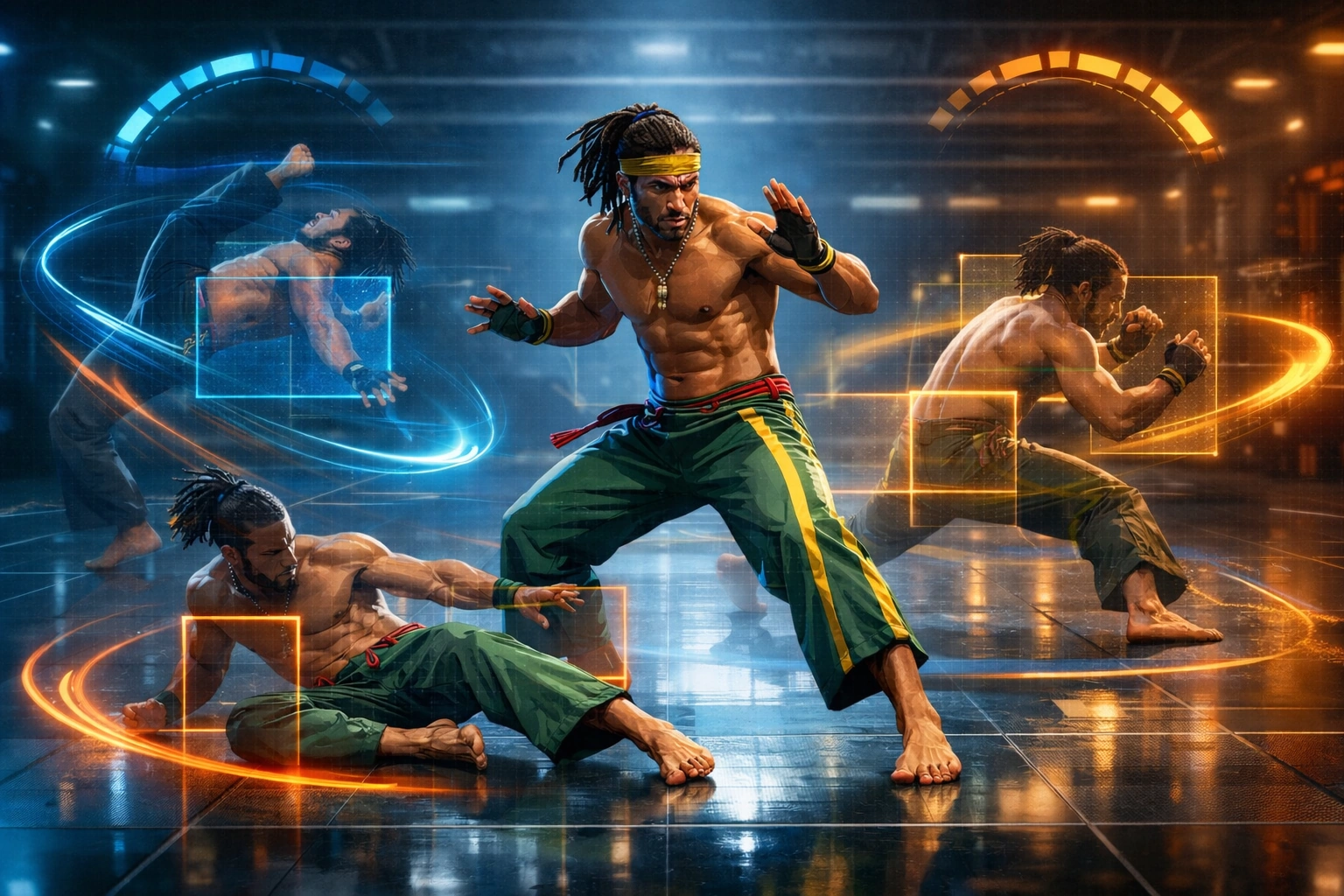
He debuted by spinning on his head in a Brazilian city street at the start of Tekken 3, and the entire arcade exploded. Nobody had seen anything like it a fighter who danced his way through combat, cartwheeling under attacks, kicking from handstands, and flowing between stances like he was performing for a crowd rather than surviving a fight. Nearly three decades later, Eddy Gordo is still one of the most instantly recognizable, hotly debated, and mechanically fascinating characters in fighting game history.
Who Is Eddy Gordo?
Eddy Gordo (エディ・ゴルド) is a Brazilian Capoeira master and one of the most iconic fighters in the Tekken franchise. He made his debut in Tekken 3 (1997) and has appeared in every main installment of the series since, most recently as the first DLC character in Tekken 8, released in April 2024.
Basic profile:
| Detail | Info |
|---|---|
| Origin | Brazil |
| Fighting Style | Capoeira |
| Height | 188 cm (6’2″) |
| Weight | 89 kg (196 lbs) in Tekken 8 |
| Age | 30 (Tekken 8) |
| First Appearance | Tekken 3 (1997) |
| English Voice | Marcellus Nealy (in-game); Roger Craig Smith (Tekken 6 cutscenes) |
| Portuguese VA | Marcos Nazareth (Tekken 7–8) |
Eddy Gordo’s Full Backstory
Eddy’s story is one of the most genuinely tragic in the Tekken series all the more striking given that his fighting style looks like pure celebration.
Origins A Life Destroyed at 19
Eddy was born into one of the wealthiest families in Brazil. His father was a prominent industrialist, and Eddy’s future was secure. Then, at 19, he came home from school to find his father shot and dying. His father had been systematically targeted by a powerful Brazilian drug cartel known as “the Organization” a criminal network he had been secretly fighting to dismantle.
With his last breaths, Eddy’s father begged his son to confess to the murder not because Eddy was guilty, but because prison was the only place that could keep Eddy safe from the cartel’s reach while he was young and vulnerable. Eddy honored his father’s dying wish. He confessed to a murder he didn’t commit and went to prison at 19.
Eight Years in Prison Finding Capoeira
Behind bars, Eddy crossed paths with an old master a man who recognized something in the young Brazilian and agreed to teach him Capoeira. Eddy spent all eight years of his sentence training. What began as survival became mastery. By the time Eddy walked out of prison, he had become one of the most skilled Capoeira practitioners alive. He emerged with two goals: find his father’s real killers and destroy them.
Tekken 3 The Hunt Begins
Hearing that the Mishima Financial Empire the shadowy organization that sponsored the King of Iron Fist Tournament was somehow connected to the cartel that had destroyed his family, Eddy entered Tekken 3 to get closer to the truth. His non-canonical ending depicts him confronting his father’s true killer.
His appearance in Tekken 3 was a cultural phenomenon. Motion capture for Eddy’s movements was performed by Mestre Marcelo Pereira, a Brazilian Capoeira grandmaster who had conducted international Capoeira seminars in San Francisco Namco reached out to him specifically to ensure the style was represented authentically. Eddy became an immediate fan favorite, with Electronic Gaming Monthly calling him “the current fan favorite of the Tekken 3 cast” in early 1998.
Tekken 4 Replaced by Christie
In Tekken 4, Eddy was effectively replaced on the roster by Christie Monteiro the granddaughter of his Capoeira master. The development team, who had originally wanted a female Capoeira character for Tekken 3, finally had the technology to create one. Eddy appeared only as an alternate costume for Christie in the console release.
Canonically, Eddy was absent from the fourth tournament. Christie entered searching for him.
Tekken 5 and 5: Dark Resurrection A Dying Master
Eddy returned as a separate character in Tekken 5: Dark Resurrection, though his moveset remained shared with Christie. More importantly, Tekken 5 introduced a new driving force: his beloved Capoeira master Christie’s grandfather had fallen terribly ill with an incurable disease.
With nowhere else to turn, Eddy approached Jin Kazama, who had become head of the Mishima Zaibatsu. Jin agreed to fund medical treatment for the master in exchange for Eddy joining the Tekken Force and participating in the Zaibatsu’s destructive operations.
Knowing full well the weight of what he was agreeing to, Eddy accepted. He fought in the Tekken Force’s morally compromised missions, sacrificing his integrity to save the man who had given him a reason to live. His master died anyway the disease claimed him before the treatment could work.
Tekken 7 Revenge, Defeat, and Rescue
Devastated and adrift, Eddy abandoned the Tekken Force and made his way to G Corporation’s Millennium Tower with one goal: make Kazuya Mishima pay for his father’s death. He fought through floors of G Corp soldiers. He reached Kazuya.
He lost. “Is this how my life is destined to end? Unable to exact vengeance or atone for my sins…?” Eddy’s last thoughts as Kazuya stood over him.
Then Yoshimitsu appeared from nowhere, rescued Eddy from the brink of death, and helped him reconnect with an unexpected figure from his past someone he hadn’t seen in ten years, who shared his desire to see the world freed from Kazuya’s rule.
Tekken 8 Redemption and Return
In Tekken 8, Eddy enters the story carrying the weight of everything he’s lost: his father, his master, his years of service to a cause that didn’t deserve him. But for the first time in the series, there’s something different in his arc a determination to redeem himself rather than simply destroy.
The official Tekken 8 profile frames his motivation with a line that has become central to his identity in this installment: “No matter what hardships people face, they can always rise again.”
Eddy launches into a grueling training regime, refining his Capoeira to levels his master never saw. He enters the eighth King of Iron Fist Tournament not just for revenge but to prove, to himself, that everything he sacrificed meant something.
Capoeira Eddy’s Fighting Style Explained
To understand how Eddy plays, you first need to understand what Capoeira actually is. Capoeira is a Brazilian martial art developed by enslaved Africans in the 16th century. It was disguised as a form of dance practitioners camouflaged combat training as music and movement to avoid detection by authorities. The result is a fighting style that appears rhythmic, acrobatic, and even playful on the surface, while containing lethal kicking techniques, sweeps, takedowns, and unpredictable attacks underneath.
The style is characterized by constant fluid movement practitioners rarely stand still, constantly swaying and shifting their weight (a movement called the ginga). Attacks come from unexpected angles: spinning kicks, headbutts, handstand kicks, cartwheels into strikes, and low sweeping leg attacks that exploit the opponent’s center of gravity.
This is precisely what makes Eddy so visually distinctive in Tekken. While other fighters stand in fighting stances and execute clearly readable attacks, Eddy flows. He dips into low stances, goes to handstands, cartwheels through neutral, and throws kicks from angles that don’t map to conventional fighting game literacy. For new players, reading Eddy is genuinely difficult because his attack geometry simply doesn’t look like what they’ve been trained to react to.
Eddy Gordo in Tekken 8 DLC Character Overview
Eddy arrived in Tekken 8 as the first post-launch DLC character, released on April 4, 2024. He is simultaneously one of the most beginner-accessible characters on the roster and one of the most mechanically deep once you understand his full toolkit.
His core identity in Tekken 8 is a mixup-heavy, stance-based fighter whose strength comes from keeping opponents in a constant state of uncertainty about what’s coming next. He is described by the development team as a more fluid version of his Tekken 7 incarnation more stances, smoother transitions, and the entirely new Mandinga resource system.
Tekken 8 Changes From Tekken 7
Players returning from Tekken 7 will notice significant differences. Key changes include:
- Terremoto (ff+3) — New advancing low move that transitions into Negativa stance; becomes a Launcher in Heat mode
- Lunging Brush Fire (b+3+4) — Eddy’s old ff+3 has been remapped to this input; now a Heat Engager
- Vassoura (u+1+2) — No longer has the backward and forward variants from previous games
- Stance transitions — Overall smoother and faster, enabling more creative offensive strings
- Mandinga system — A completely new mechanic that didn’t exist in Tekken 7 (explained in full below)
Eddy’s Stances The Core of His Gameplay
Eddy’s identity is defined by his stances. Managing them effectively is the difference between button-mashing and actually playing the character.
Negativa (RLX) The Low-Profile Stance
Eddy lowers himself toward the ground almost lying on his side and from here unleashes his most effective mixup options and damaging combos. The Negativa stance is low profile by design, which means it naturally avoids high attacks. Opponents who panic and throw highs will miss completely. To enter Negativa: press d+3+4 from neutral (or via certain move transitions).
From Negativa, Eddy’s attack options split between mids and lows the classic 50/50 that makes him so frustrating to defend against. The opponent must choose between blocking low (leaving themselves open to mids) or blocking mid (getting hit by the sweep). Eddy can also activate his Rage Art from Negativa stance, which opens up additional mind-game options when at low health.
The key strength of Negativa is that it’s hard to read opponents who aren’t familiar with Eddy’s specific attack angles from this position will struggle to react appropriately.
Bananeira (HSP) The Handstand Stance
Eddy literally stands on his hands. This looks ridiculous. It is extremely effective.
Bananeira is a mixup tool that becomes significantly stronger once Eddy has built Mandinga stacks. From handstand, many of his attacks are mid-hitting which surprises opponents who assume a handstand means overhead kicks. Bananeira also enables unique throws using Eddy’s legs (1+3 in Bananeira is particularly difficult to read).
The handstand can be entered after a sidestep: f+1+2 (sidestep left into handstand) or b+1+2 (sidestep right into handstand). Understanding when to use Bananeira vs. Negativa and how to transition fluidly between them is the core of Eddy’s mid-to-high level gameplay.
The Mandinga System Eddy’s Unique Mechanic
The Mandinga system is the most significant new addition to Eddy’s toolkit in Tekken 8. It’s represented by a yellow and green swirl symbol beneath his health bar and functions as a buildable resource that unlocks enhanced moves.
How it works:
- Eddy can accumulate up to two stacks of Mandinga per round
- Stacks reset between rounds
- Heat activation automatically grants one stack
- Additional moves that build Mandinga: RLX 3+3, HSP 2+3, d/b+4+4, QCB+4
What one stack unlocks:
- b+4 A mid attack that’s positive on block; Eddy transitions to neutral stance after
- New Bananeira followups that expand mixup options significantly
What two stacks add:
- Stage break on 3+4
- Knockdown after b+4
- Damage increases on Bananeira moves
- The full low/mid 50/50 from Bananeira becomes much harder to escape because the powered-up versions punish incorrect reads more severely
The key insight about Mandinga is that it shouldn’t be treated as a separate “mode” to activate deliberately it’s a resource that should flow naturally out of Eddy’s normal offense. Building stacks happens as a byproduct of playing his gameplan, and spending them should feel like an extension of the attack string rather than a gear shift.
Key Moves to Learn First
Eddy’s full move list is extensive. New players should focus on these core moves before exploring the deeper toolkit:
1,2 (Jab String) A quick and reliable two-hit string. Safe on block at -3 frames and strongly positive on hit at +8. Use this for punishing opponents after a blocked move and for checking how defensive they’re playing.
3 (Auto-Combo) Eddy’s infamous auto-combo triggered by holding the left kick button. Surprisingly effective and deals solid damage. Particularly strong against players who don’t know how to interrupt it mid-string. Against experienced opponents who know the defensive answer (a quick mid attack during the stance transition), use this sparingly as a conditioning tool rather than a primary offense.
d/b+3 (Low Sweep) A reliable low attack that’s one of Eddy’s primary tools for opening up opponents who are blocking standing. Fast enough to be difficult to react to consistently.
b+2 (Mid Poke) One of Eddy’s better mid options hit-confirmable, and can be used to punish opponents who are crouching to block lows. Solid keep-out tool.
d/f+3 (Whiff Punisher) Eddy’s go-to whiff punisher. When an opponent’s attack misses and they’re in recovery, this is the fastest way to convert into damage.
Rage Art “Enchente de Axe” When activated, Eddy transports his opponent into a stylized Capoeira sequence accompanied by ancestral spirits. Beyond being visually spectacular, it can be activated from Negativa stance which makes the mind-game of entering Negativa even more layered because opponents must account for the Rage Art as an option.
Starter Combos
These are reliable, consistent combo routes for players learning Eddy in Tekken 8. Notation follows standard Tekken input format (1=LP, 2=RP, 3=LK, 4=RK).
Basic BnB (Bread and Butter): Launcher → 3,4 → d/f+2 → 3,4 → 4
Heat Smash Route: Heat Smash → RLX 3,3 → 4
Wall Carry: Launcher → 3,4 → b+2,3 → wall → 1,2 → b+2 → Wall Splat Ender
Mandinga-Enhanced: Launch → 3,4 → HSP 3 (with Mandinga) → 4,3 → Stage Break
As with any Tekken character, these routes should be drilled in Practice Mode before taking them online. Eddy’s combos can drop if stance transitions aren’t timed properly fluency with his stance shifts makes the difference between consistent damage and dropped extensions.
How to Play Eddy Gordo The Gameplan
The overarching strategy: Eddy is a mixup character whose win condition is making the opponent afraid to commit to any defensive option. His offense branches into highs, mids, and lows from both standing and stance positions and crucially, the attack type doesn’t always match the visual read of the stance. Bananeira (handstand) looks like overhead attacks but delivers mids. Negativa (low crouch) looks like low attacks but delivers mids.
The psychological goal is to make the opponent freeze unsure whether to block low or block mid and then punish whatever they commit to.
Phase 1 — Establish the threat. Open with 1,2 jab strings and d/b+3 lows. Make the opponent respect your low game. Once they start crouching, transition into Negativa and hit them with mid attacks from the 50/50.
Phase 2 — Build Mandinga naturally. Don’t force it. RLX 3,3 and HSP 2,3 build stacks in the course of normal offense. Heat activation gives you one for free. Let the stacks come to you.
Phase 3 — Expand options with stacks. Once Mandinga is active, the Bananeira stance becomes significantly more threatening. The enhanced b+4 mid becomes plus on block, giving you genuine pressure rather than just risk. Introduce the more advanced HSP 50/50s into your offense.
Phase 4 — Stay unpredictable. Eddy’s biggest weakness is predictability. Experienced opponents who have labbed his gameplan know when his moves are punishable and will intercept specific patterns. Change your timing, mix up your entry points into stances, and avoid relying on the auto-combo (Button 3) against anyone who knows the counter.
How to Beat Eddy Gordo The Defensive Answer
Interrupt the auto-combo. His 3-auto-combo is iconic and annoying. The defensive answer is a quick mid attack during the stance transition after his second hit. Once you demonstrate you know this counter, experienced Eddy players will stop using it as a primary tool.
Sidestep left. Many of Eddy’s approach tools including ff+3 and WR+3 are weak to sidestepping left (SWL). Practice the sidestep direction specifically against Eddy rather than generic evasion.
Backdash the RLX 50/50. Several of Eddy’s RLX mixup options are escapable via back-dash. FC d/f+3 and Heat Smash into RLX 3,3 can be avoided with a clean backdash and then punished.
Use Heat Burst. Eddy spends significant time airborne during attack strings. Heat Burst can float him out of the air during these windows, interrupting his pressure and converting into your own damage.
Don’t panic block. Panicking against Eddy’s visual chaos is exactly what he wants. His moves are punishable on block you just need to know which ones. d/f+3 and SS+3+4 are reliable whiff punishers after you block an extended string.
Eddy Gordo Across Every Tekken Game
| Game | Role |
|---|---|
| Tekken 3 (1997) | Full debut iconic capoeira introduction, motion-captured by Mestre Marcelo Pereira |
| Tekken Tag Tournament (1999) | Playable; tag partner synergy with Christie and other fighters |
| Tekken 4 (2002) | Replaced by Christie; appears as alternate costume only |
| Tekken 5 (2004) | Shares Christie’s moveset; Tekken 5: Dark Resurrection returns him as separate character |
| Tekken 6 (2007) | Full return; serves as boss in Scenario Campaign’s 28th level |
| Tekken Tag Tournament 2 (2011) | Playable in tag format |
| Tekken 7 (2015) | Full moveset; seeks revenge against Kazuya; defeated and rescued by Yoshimitsu |
| Tekken 8 (2024) | First DLC character; Mandinga system added; redemption arc begins |
Eddy Gordo’s Cultural Legacy
Beyond his gameplay, Eddy carries genuine cultural significance. Capoeira is a martial art with deep roots in the African diaspora and Brazilian history developed by enslaved people as a form of resistance, coded as dance so it could be practiced openly. Bringing that art form to one of the biggest fighting game franchises in the world, with authentic motion capture from a real Capoeira master, introduced it to millions of players who had never encountered it before.
Complex ranked Eddy as the 17th “Most Dominant Fighting Game Character,” noting: “You either think this dancing brawler is the greatest thing to happen to Tekken or you think he’s the cheesiest character in the entire series.” That split reaction is part of what makes him one of the most discussed characters in the FGC.
He has been a polarizing presence at every level of competitive Tekken beloved by players who love expressive, stance-heavy characters and criticized by veterans who felt his low skill floor made him too accessible for online play. In Tekken 8, the Mandinga system and enhanced stance mechanics address that criticism somewhat, raising the ceiling and rewarding genuinely skilled play more distinctly.
Quick Character Reference
| Full Name | Eddy Gordo (エディ・ゴルド) |
| Origin | Brazil |
| Fighting Style | Capoeira |
| Age | 30 (Tekken 8) |
| Key Relationships | Christie Monteiro (student), Capoeira Master (mentor), Yoshimitsu (rescuer) |
| Main Rivals | Kazuya Mishima, G Corporation |
| Tekken 8 Status | DLC Character (first post-launch) |
| Key Mechanic | Mandinga stacks, Negativa stance, Bananeira stance |
| Skill Floor | Low (beginner-accessible) |
| Skill Ceiling | High (stance mastery, Mandinga optimization) |
| Rage Art | Enchente de Axe |
FAQs about Eddy Gordo
Is Eddy Gordo a good character in Tekken 8?
What fighting style does Eddy Gordo use?
Is Eddy Gordo DLC in Tekken 8?
What is Eddy’s Mandinga system?
What are Eddy’s two main stances?
If you’re building out your Tekken 8 roster knowledge or comparing Eddy against other fighters, our complete Tekken 8 tier list of the best characters ranks every fighter in the current meta. For deeper technical breakdown on match-by-match performance, our Tekken 8 patch notes analysis covers how recent updates have shifted character rankings. And if you’re running into PC performance issues while playing, the Tekken 8 low FPS fix guide has everything you need to get the game running smoothly.
