

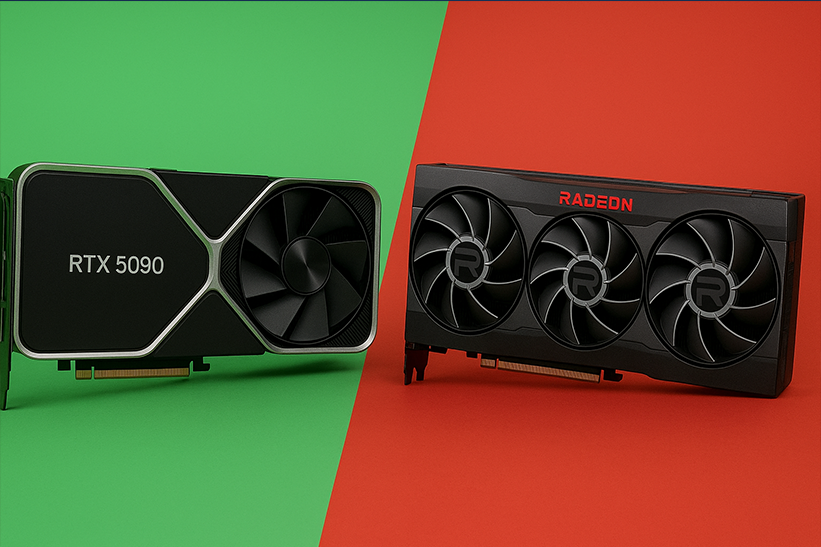
The battle between NVIDIA’s RTX 5090 and AMD’s Radeon RX 7900 XTX represents more than just a comparison of two powerful graphics cards — it’s a clash of ecosystems, philosophies, and long-term platform strategies. The RTX 5090, built on NVIDIA’s latest architecture, pushes raw performance, AI acceleration, and advanced ray tracing to new heights. Meanwhile, the RX 7900 XTX focuses on exceptional raster performance and value-driven efficiency within AMD’s open and accessible ecosystem.
Choosing between the two requires evaluating performance, software features, supported tools, pricing, and the user experience across gaming, productivity, and AI applications. Recognizing these ecosystem differences helps readers feel assured in making an informed choice.
Key Features to Look For in the RTX 5090 vs. RX 7900 XTX Battle
1. Ecosystem Strengths
NVIDIA (RTX 5090)
NVIDIA’s ecosystem is built around powerful proprietary technologies. DLSS, Frame Generation, Reflex, CUDA, and NVENC create a well-integrated platform for gamers, creators, and AI users. NVIDIA’s Game Ready drivers often deliver immediate optimizations for major releases. For creative workloads, its Studio drivers provide enhanced stability. The company’s ecosystem is robust in AI, machine learning acceleration, and professional content creation.
AMD (RX 7900 XTX)
AMD takes an open and flexible approach. Technologies like FSR and HYPR-RX work across a wide range of hardware, not just AMD GPUs. The company’s Radeon Software suite is feature-rich, stable, and designed for user control. AMD’s ecosystem emphasizes accessibility, lower platform costs, and strong raster graphics performance without needing proprietary solutions. Its open standards philosophy appeals to developers and users who want more freedom and less vendor lock-in, making it a practical choice for budget-conscious users.
Ecosystem Summary
- NVIDIA excels in AI tools, proprietary performance features, and professional workflows.
- AMD excels in open standards, value, and broad compatibility.
2. Price-to-Performance
RTX 5090
The RTX 5090 sits firmly in the ultra-premium tier with a price tag to match. It delivers unmatched performance in ray-tracing, high-resolution gaming, and AI workloads — but at a cost that often makes it an enthusiast-only option. Its price-to-performance ratio is lower simply because of the high entry price.
RX 7900 XTX
The RX 7900 XTX has remained one of the best 4K GPUs for the money. Its significantly lower price compared to NVIDIA’s flagship makes it highly appealing to gamers who want maximum performance without overspending. Even if it falls behind in ray tracing and AI-supported tasks, it offers tremendous value in pure raster performance.
Price Summary
- RTX 5090 = ultimate performance but poor value for the money.
- RX 7900 XTX = excellent 4K performance with much better value.
3. Software & Features
NVIDIA Features
- DLSS Super Resolution & Frame Generation
- Reflex latency reduction
- Highly advanced ray tracing hardware
- CUDA acceleration for creative and scientific workloads
- Deep integration into AI frameworks
- NVENC encoder for streaming and content creation
NVIDIA’s software stack significantly enhances gameplay, streaming, editing, and AI model performance.
AMD Features
- FSR upscaling (vendor-neutral)
- HYPR-RX one-click optimization
- Smart Access Memory (paired with Ryzen CPUs)
- Good driver-level tuning and monitoring tools
- Strong replay and recording features
While AMD’s AI-assisted features are less advanced, its gaming-optimization tools are straightforward and effective.
Software Summary
- NVIDIA wins in AI, upscaling quality, and creative tool performance.
- AMD wins in simplicity, openness, and efficient gaming tools.
4. Use Case — Which GPU Is Best for You?
Choose the RTX 5090 if you:
- Want the absolute fastest GPU for gaming, ray tracing, and AI-assisted features.
- Do heavy video editing, 3D r
- endering, AI model training, or scientific computation.
- Value features like DLSS, Frame Generation, and CUDA for professional tasks.
- We are building a high-end system with a powerful PSU and intense cooling.
Ideal for: Enthusiasts, creators, AI developers, and gamers who demand ultimate performance.
Choose the RX 7900 XTX if you:
- Want top-tier 4K raster performance without spending flagship-level money.
- Prefer AMD’s open and user-friendly ecosystem.
- Don’t rely on CUDA or heavy AI workloads.
- Want good performance with significantly lower power consumption and heat.
Ideal for: Value-driven gamers, budget-conscious high-end users, and those who prefer open standards.
5. Power, Thermals & Build Considerations
RTX 5090
- Extremely high power draw
- Requires strong cooling
- Needs a large PSU
- Better suited for spacious, high-airflow cases
RX 7900 XTX
- Considerably more efficient
- Easier to cool
- Compatible with more mid-range power supplies
- Better for compact or quiet builds
Availability and long-term support are crucial. NVIDIA tends to provide longer, more frequent feature updates, especially those tied to AI and creative tools, which can reassure readers about ongoing value and reliability.NVIDIA tends to provide longer, more frequent feature updates, especially those tied to AI and creative tools.
AMD provides consistent driver updates and often improves performance over time, especially for raster workloads.
Conclusion: Choosing the Right GPU in the Ecosystem War
The comparison between the RTX 5090 and the RX 7900 XTX comes down to performance needs, ecosystem preference, and budget.
Choose the NVIDIA RTX 5090 if you want unmatched performance, cutting-edge ray tracing, the best AI-assisted gaming tools, and superior support for creative or scientific workloads. It is the ultimate powerhouse — but demands a premium price and a robust system to support it.
Choose the AMD Radeon RX 7900 XTX if you want excellent 4K gaming performance at a significantly better value, prefer open software tools, and like a more power-efficient, easier-to-integrate GPU. It’s the wise choice for most gamers who prioritize performance-per-dollar over bleeding-edge features.
Each card wins in different categories but your use case ultimately decides the true champion.
